Get Full Government Meeting Transcripts, Videos, & Alerts Forever!
Get email alerts on the Human Services Integrity topic
No spam. Unsubscribe anytime.
House passes human services program-integrity bill after hours of amendment fights
Summary
The Minnesota House on May 11 passed a human services program-integrity bill after lengthy debate on amendments about periodic data matching, homelessness reporting, provider vetting, whistleblower reporting and eligibility limits; the final bill passed 107–21. Several high-profile amendments—including removing a sunset on the periodic data-matching report and adding criminal penalties for failing to report fraud—were rejected on roll calls.
The Minnesota House passed a broad human services program-integrity bill on May 11, sending the measure to the next step after a final roll call that the clerk recorded as 107 yeas and 21 nays.
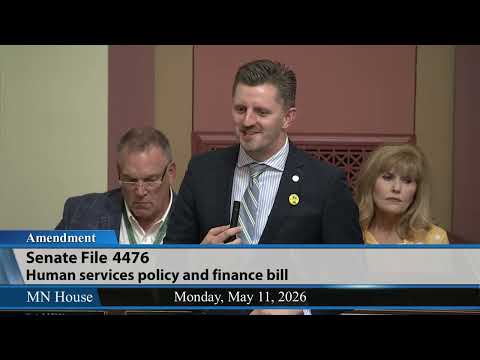
The measure, described by sponsors as an effort to strengthen fraud prevention, provider vetting and program oversight, generated extended floor debate and multiple roll-call votes on amendments. Representative Schultz, who introduced several amendments, told colleagues the bill ‘‘simply removes the sunset’’ on the periodic data-matching report and would ensure ‘‘the department must deliver this report to us every single year’’ so the Legislature can verify eligibility for medical assistance.
Supporters of the data-matching amendment argued the periodic reports are an essential accountability tool. Representative Robbins said department performance on the reports had fallen short: after the public health emergency the required reports were not delivered on schedule, and the department ‘‘has failed in its obligation to do the periodic data matching and to fulfill its reports to the legislature.’’ Opponents said timing and alignment with federal HR1 changes complicated immediate statutory action; Representative Norm argued that recent federal compliance work and pending operational changes made the statutory change premature. The roll call on that amendment was announced on the floor as 63 yays and 67 nays and the amendment was not adopted as announced.
Lawmakers also debated an amendment to require the Department of Human Services to report outcomes and costs for homelessness programs and to enable recoupment of funds where reporting or outcomes were lacking. Supporters said the amendment would let the Legislature evaluate whether ‘‘tens of millions’’ spent on homelessness yields durable results; opponents said existing reporting and stakeholder processes were already addressing those needs. That amendment failed on a recorded vote announced as 62 yays and 67 nays.
A separate amendment that would have barred people convicted of violent crimes from receiving certain publicly funded medical assistance prompted clashes over federal Medicaid rules and emergency-care obligations. Proponents framed the change as protecting taxpayers and victims; opponents warned that federal law requires certain coverage and that removing coverage could shift uncompensated emergency-care costs to hospitals. The clerk announced a tally of 53 yays and 17 nays on the floor; the transcript records the amendment as not adopted.
Not every floor change failed. An amendment to align peer recovery specialist language with Centers for Medicare & Medicaid Services (CMS) guidance — intended to avoid imposing background-check requirements that would exclude people with lived experience from peer recovery roles — was adopted unanimously as announced (127 yeas, 0 nays). Other amendments intended to strengthen upfront financial vetting of providers, to add criminal penalties for failing to report credible allegations of theft or embezzlement to the Legislative Auditor, and to pause or broaden payment prohibitions for providers with credible allegations of fraud were debated and repeatedly rejected on recorded votes as announced on the floor.
Floor speakers repeatedly described program-integrity goals as twofold: protect taxpayer dollars and ensure services reach eligible Minnesotans. Representative Schultz argued that stronger statutory requirements, reporting and vetting are ‘‘pro‑taxpayer’’ measures to prevent fraud. Colleagues who opposed some amendments warned lawmakers not to inadvertently block new or emerging providers, to create implementation problems with federal Medicaid rules, or to criminalize employees or whistleblowers who have privacy or safety concerns.
The bill received a third reading on the floor; after closing remarks the clerk reported the final passage tally and the bill was passed in its title.
What comes next: sponsors and committee leaders said several disputed provisions may be subject to conference committee negotiations. Lawmakers also calendared additional measures for floor debate the next day, including a disability-accommodations bill the House agreed to calendar for further consideration.
Votes at a glance (as announced on the floor): A5 (remove sunset on periodic data matching) — announced 63 yays, 67 nays (amendment not adopted). A6 (homelessness outcomes/reporting) — announced 62 yays, 67 nays (not adopted). A8 (ineligibility for violent-crime convictions) — announced 53 yays, 17 nays (transcript records not adopted). Peer recovery specialist CMS-alignment amendment — announced 127 yeas, 0 nays (adopted). Final passage — announced 107 yeas, 21 nays (bill passed).
The House adjourned and will reconvene for the next calendar day to consider additional measures.
Direct quotes in this account are taken from floor debate and are attributed to the speakers who made them on the record.