Get Full Government Meeting Transcripts, Videos, & Alerts Forever!
Get email alerts on the Low Carbon Building Policy topic
No spam. Unsubscribe anytime.
Eugene commission trims draft guidance on low‑carbon building materials ahead of council packet
Summary
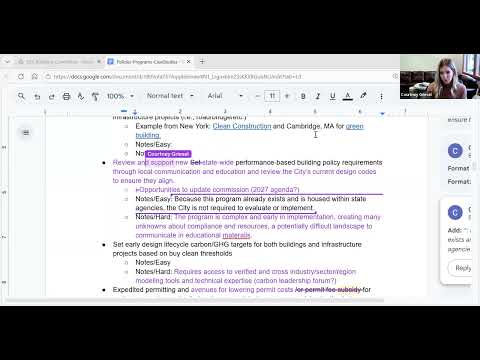
A city-appointed commission in Eugene pared technical detail from a draft informational paper for the city council, agreed to remove 'easy/hard' labels and 'Buy Clean' thresholds for now, and kept references to expedited permitting, mass timber incentives and an appendix of resources; staff will finalize edits for the council packet due to Danielle by the 13th.
A city‑appointed commission in Eugene met to finalize a draft informational paper on low‑carbon building materials and policy options, agreeing to streamline language and defer technical thresholds until staff can verify details. Chair (speaker 2) opened the meeting saying, "Our goal today is to go through the draft and get something in a that's ready enough to share with the commission."
The group decided to keep the document high level for council readers and to add a short appendix of links and resources rather than detailed analysis. A committee member (speaker 3) argued against labeling items "easy" or "hard," saying, "The easy and the hard don't seem critically important to me to communicate at this stage," and members agreed to remove that framing. Participants also agreed to remove specific numerical details that may change and to ask staff to confirm budget and program numbers before publication.
The commission discussed how the city might engage with new statewide, performance‑based building policy requirements. One member (speaker 3) suggested simply flagging that state activity rather than recommending immediate implementation by the city, while staff (speaker 1) clarified that "we're not the regulatory implementer" and that the draft should present the policy as something to which the city is subject and that council should be aware of.
A technical debate emerged over "Buy Clean" thresholds and modeling. One participant (speaker 4) said, "I don't know what buy clean means," and members agreed to eliminate explicit Buy Clean threshold language from the draft and to defer life‑cycle modeling details to an appendix or later staff work. The paper will retain a general reference to potential incentives — such as expedited permitting or reduced permit fees — as ways the city could encourage lower‑embodied‑carbon materials, but the commission avoided prescribing regulatory steps.
Mass timber and other bio‑based materials were discussed as examples of lower‑carbon construction strategies. Members recommended referencing local mass‑timber projects without exhaustive lists and identifying possible measures to make such projects more feasible (reduced fees, design‑standard alignment, or incentives). The draft will note opportunities for the city to support implementation through education and training for inspectors and contractors rather than claiming the city is the primary implementer.
The commission removed tangential items — including a referenced "empty homes tax" example — that members agreed did not belong in this council‑facing informational paper. Staff agreed to verify technical details (including pilot program budget figures mentioned in the discussion) and to circulate a lightly word‑smithed draft by Friday; materials must be with Danielle by the 13th to be included in the council packet.
No formal motions or votes were recorded at the meeting; the session focused on editorial decisions, scope clarifications and assigning follow‑up tasks to staff.