Get Full Government Meeting Transcripts, Videos, & Alerts Forever!
Get email alerts on the Murf Pilot topic
No spam. Unsubscribe anytime.
Metro pilot offers short-term rental aid to move people into housing faster
Summary
Metro’s Office of Homeless Services presented the Metro Rapid Response Fund (MURF) pilot — a diversion-focused program pairing short-term financial assistance with intensive case management — and reported 91 referrals to date, with 40 households already housed; the pilot has no set end date and officials say outcome evaluation will guide next steps.
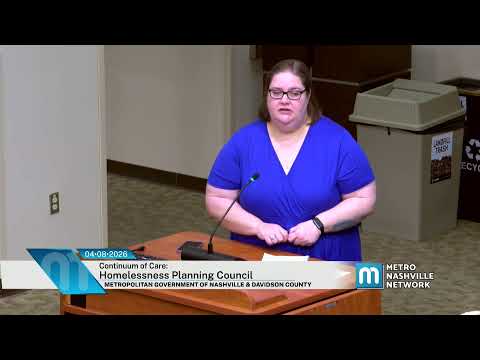
Amoris Gomez, landlord engagement manager for the Office of Homeless Services, presented the Metro Rapid Response Fund pilot (MURF) to the Homelessness Planning Council, saying the program is “designed to strengthen our homelessness response system through the diversion approach” by helping households secure housing sooner.
The pilot pairs short-term financial assistance — security deposits, arrears payments, first month’s rent, short rental subsidies and utility support — with intensive case management supplied by community partners. Gomez said the goal is to “move into housing faster and test whether earlier intervention leads to a stronger long-term outcome and prevent the return to homelessness.”
Why it matters: Council members pressed for clearer performance markers and public transparency because MURF creates an alternate local prioritization path that can reach households who do not score highly under HUD-funded coordinated-entry assessments but still face risk of prolonged homelessness. Gomez said the pilot focuses on participants who are “housing ready” — meaning they have essential documents and at least some income — and that case managers monitor sustainability through monthly reviews and weekly or biweekly contacts.
Early outcomes and partners: Gomez reported OHS has received 91 MURF referrals so far and that 40 households have secured housing while 51 are actively working with OHS staff and case managers. She said referrals come from OHS street outreach teams, emergency family shelters and the Department of Veterans Affairs. When asked which community partners are involved, Gomez named the Nashville Rescue Mission, OHS outreach teams and the VA.
Veteran supports: A VA-affiliated supervisor addressed veteran-specific practices, saying MURF’s approach is “very similar” to the federal Supportive Services for Veteran Families (SSVF) bridge programs and noting the importance of pairing short-term aid with licensed clinical and supportive services to promote sustainability.
Transparency, timing and data: Council members repeatedly asked how selection decisions are made and when aggregate data will be shared. Gomez said the pilot is intentionally limited to a small set of referral partners while internal processes are refined; she added that the program will publish requested data after the pilot phase and pointed members to a help desk email (murfhelp@nashville.gov) for follow-up information. On the pilot’s duration she said there is currently no fixed end date and that evaluation timelines (three months, six months, year) will guide adjustments.
Funding mechanics and flexibility: When asked about caps or standard budgets per household, Gomez said assistance varies by client need and is determined case-by-case; OHS emphasized intentional site-selection and budgeting to encourage placements clients can sustain after the short-term subsidy ends.
What’s next: Members urged OHS to define reporting benchmarks and a public data cadence before expanding referral pathways. Gomez and other staff said they will continue refining eligibility and measurement, share the MURF rubric on request, and bring updated findings back to the Council prior to any broader rollout.
Ending note: The Council did not adopt any new policy during the presentation; members tasked staff with follow-up reporting and clarity on metrics and transparency.