Get Full Government Meeting Transcripts, Videos, & Alerts Forever!
Get email alerts on the Public Safety topic
No spam. Unsubscribe anytime.
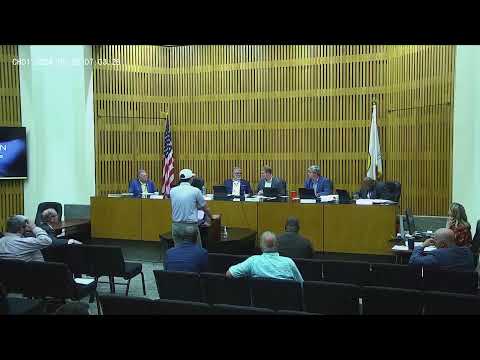
Axon pitches body cameras, AI tools and drones to Decatur council; city questions legal and budget implications
Summary
Axon representatives briefed Decatur City Council on a combined evidence-management, AI and drone program that the company says could cut report-writing workloads and reduce response times; council members raised questions about costs, court use of AI outputs, training and privacy/operational waivers.
Axon representatives presented a multi-part proposal to the Decatur City Council at its May 11 work session, pitching an integrated package of body cameras, an evidence-management platform, AI-enabled transcription and translation tools, and an autonomous drone-as-first-responder (DFR) deployment.
Kyle Bernon, an Axon regional representative, said the company’s evidence.com ecosystem could consolidate ‘‘all your digital evidence’’ and cited a Fort Collins case study in which report-writing time was cut in published materials by up to 67%; Bernon said a conservative estimate for Decatur would be about a 40% reduction in report-writing workload. Axon’s presenters said the platform archives an audit trail of recordings and supports a ‘‘policy chat’’ feature that searches an agency’s uploaded policies and returns references in real time.
On drones, Chris (Skyio/Axon’s drone partner) described a five-zone docking strategy for Decatur that Axon’s analysis of call-for-service data suggested could let drones respond to roughly a third of calls initially, with about 30% of those responses occurring in under three minutes; as docks are added, presenters said the share could rise toward 45%–50% of calls within three minutes. Axon proposed a phased ‘‘crawl/walk/run’’ deployment and presented contract-level cost estimates including a baseline roughly $1.1 million per year over a 10-year term and incremental annual costs for adding docks.
Council members focused questions on staffing and liability, asking whether the tools would reduce headcount or merely mitigate workloads, how AI-generated transcripts and translations would fare in court, and what training and support Axon would provide. Bernon said AI outputs would be overseen by humans for evidentiary use—citations and transcripts would be reviewed by staff or human translators when taken to court—and described an included customer‑success and training program. Presenters said some future AI features would be opt‑in at a fixed cost to avoid repeated council approvals.
Presenters cited pilot implementations in Alabama cities including Dothan, Tuscaloosa and Huntsville and offered ROI estimates: an asserted $11.1 million in productivity gains over 10 years from AI and staff time savings and roughly $13 million in avoided vehicle-response costs when comparing $250 per responded call over a 10-year contract; Axon characterized those figures as drawn from partner data and prior city projects.
Council members requested more detail on procurement costs, operational policies (permissions, who can view footage), legal reliability in court, and the need for FAA or FCC waivers for beyond-visual-line-of-sight drone operations. Several councilors emphasized the need to review the vendor contract, privacy and policy permissions, and local oversight before any procurement decision.
The presentation closed with staff saying they would bring cost and contract details forward for council consideration at a later meeting.