Get Full Government Meeting Transcripts, Videos, & Alerts Forever!
Get email alerts on the Land Use topic
No spam. Unsubscribe anytime.
Council adopts Hopewell PUD with compromise on permanent affordability and energy commitments
Summary
After hours of debate, Bloomington—ity Council adopted the Hopewell planned unit development (Ordinance 2026-06) and approved a compromise affordability package (minimum 35% permanently affordable, goal 50%) plus a written energy-efficiency commitment; council withdrew a prior all-electric reasonable condition amid legal and feasibility concerns.
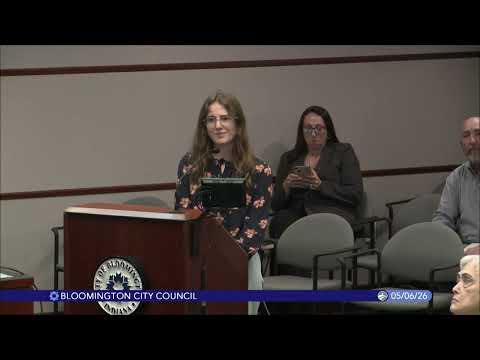
Bloomington City Council adopted Ordinance 2026-06 on May 6, 2026, approving the rezoning of a 6.3-acre site to a planned unit development (the Hopewell PUD) and attaching a set of written commitments and reasonable conditions intended to secure energy-efficiency and long-term affordability.
The council removed a previously proposed "reasonable condition six" that would have required all-electric construction after attorneys and staff flagged state legal constraints. Instead, the council voted to adopt Written Commitment No. 1, a staff-drafted energy-efficiency and electrification commitment detailing performance and inspection standards and citing a target HERS (Home Energy Rating System) score that drew technical questions from council members and staff. Director Killian Hansen told the council HERS is an industry tool that reflects building-specific variables and that a HERS target of 65 would be aggressive for small homes; Council Member Pedmont Smith and others said they could not independently verify that the proposed target exceeded baseline state code.
The central point of debate was permanent affordability. Council negotiated a compromise reasonable condition (introduced as amended RC16, adopted as RC17) that requires at least 35% of dwelling units be designated permanently affordable, with a "goal" of 50%. Within that minimum, the condition specifies a floor of 15% of all units for households at or below 90% of area median income (AMI) and 20% at or below 120% AMI. The compromise also requires the petitioner to present the legal affordability instrument(s) (for example, silent second mortgages, shared-equity, or land-lease structures), to secure how permanent affordability will be enforced, and to report to the council twice a year for five years on implementation progress.
Council members and the redevelopment commission (RDC) debated mechanisms and fiscal limits. Controller Jeff McKim and RDC representatives emphasized the redevelopment commission—udget constraints (TIF revenue horizon and existing obligations) and warned that heavy upfront public subsidy could jeopardize other public projects. Mayor Thompson and others raised fair-housing and process concerns about any approach that would require council approval of buyer-specific financing packages; the city attorney advised the adopted language should be read as requiring an implementation framework rather than buyer-by-buyer approvals.
Public commenters, nonprofit housing counselors and CDFI reps urged higher permanent-affordability targets and recommended tools such as community land trusts or ground leases; some private-property stakeholders warned that stricter conditions could make the project infeasible without additional subsidy. Petitioner representatives said the RDC supports multiple tools and requested flexibility to adapt mechanisms to buyer circumstances. In several recorded votes reported in the transcript, the council unanimously adopted Written Commitment No. 1 and later adopted the revised affordability condition (RC17) and the PUD ordinance itself.
What happens next: the ordinance and attached written commitments and reasonable conditions define the PUD pproval and the legal framework for implementation. Staff and the RDC will be responsible for producing the affordability instruments and implementation framework required by the condition; the council retained reporting and oversight through periodic updates.
Votes and formal actions: the transcript records the city clerk calling the roll for several discrete actions during the meeting: withdrawal of reasonable condition six (recorded vote reported in the transcript as passing), adoption of Written Commitment No. 1, adoption of RC17 (the adopted affordability compromise), and final adoption of Ordinance 2026-06.
Questions remaining: Council members asked for clearer, itemized cost estimates for subsidy packages (silent second amounts, land-lease valuation, and unit-by-unit feasibility), and for clarification of who would hold affordability instruments. Staff agreed to supply additional financial detail and operational plans as implementation proceeds.