Get Full Government Meeting Transcripts, Videos, & Alerts Forever!
Get email alerts on the College Disability Services topic
No spam. Unsubscribe anytime.
Bernards Township counselors outline how students with IEPs and 504s should navigate college disability services
Summary
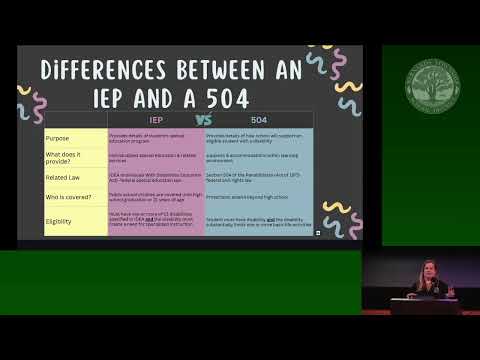
A Bernards Township School District presentation explained that IEPs do not automatically carry to college, detailed the differences between IEPs and 504 plans, described three types of college support programs, and gave parents practical steps on disclosure, documentation and self‑advocacy.
Lisa Vitali Santione, Supervisor of Special Education K–12 for the Bernards Township School District, told parents at a counseling presentation that supports students receive in high school do not automatically transfer to college and that students must take the lead in requesting accommodations. “You do have to apply for accommodations,” Santione said, adding that colleges require students to identify as a student with a disability, provide documentation and meet each institution’s deadlines.
Santione reviewed federal laws that shape supports during and after high school. She said the Individuals with Disabilities Education Act (IDEA) covers K–12 special education and the individualized education program (IEP) it enables, but “this law would cease to cover their…future plans” once a student graduates. She also explained that FERPA protects school records and that schools do not disclose an IEP or 504 plan to colleges without the student’s action. Santione described the Americans with Disabilities Act (ADA) and Section 504 of the Rehabilitation Act as civil‑rights frameworks that can provide access in post‑secondary settings when students request accommodations.
The presentation broke college supports into three program types. Structured programs are the most comprehensive: Santione said they often have certified staff, a case manager, individualized contracts and may require a separate application and fees. Coordinated services programs offer moderate monitoring and streamlined referrals to tutoring or writing centers. “Services” are the baseline, access‑focused options available at most campuses; these are student‑driven and emphasize access rather than remediation.
Santione urged parents to help students develop self‑advocacy skills well before senior year: students should be able to explain their disability, how it affects their learning, and what accommodations have helped. She recommended that families ask disability offices specific questions when evaluating colleges—staffing levels, training, common accommodations, numbers of students served and available outcome data such as retention or graduation rates.
On documentation and timing, Santione said academic testing (reading, writing, math evaluations) is often accepted for three to five years, while medical documentation is frequently valid for about one year. She warned that structured program applications often align with college application deadlines and that some programs require disclosure during the application stage. For standardized‑test accommodations, Santione advised families to give counseling staff at least eight weeks’ notice because companies that administer testing (College Board, ACT) set their own timelines and may request additional documentation.
Santione also described limits on college accommodations: while colleges provide reasonable accommodations (extended time on exams, alternative formats, assistive technology, note copies), they are not generally required to modify curricular expectations in the way IEPs sometimes do in K–12. She stressed another administrative pitfall: students typically must reactivate accommodations each semester through the college’s system.
In a question‑and‑answer session, Santione said the presentation slides and recording will be posted on the counseling department website and directed parents to Naviance and the counseling site for scholarship and financial‑aid resources. She also addressed concerns specific to student athletes, students with ADHD and scheduling strategies, recommending early campus visits and conversations with disability offices to determine program fit.
The presentation closed with a reminder that parental access to student records and information is limited once students turn 18, and a call for families to gradually build students’ independence before college. Santione encouraged parents to contact their student’s case manager or counselor with individualized questions and thanked attendees for coming.