Get Full Government Meeting Transcripts, Videos, & Alerts Forever!
Get email alerts on the Homelessness topic
No spam. Unsubscribe anytime.
Nogales police and coalition describe outreach, referrals and limited shelter capacity
Summary
Police and Mariposa Coalition leaders told council the department prioritizes welfare checks, outreach and referrals rather than specialized enforcement; the coalition counted 17 people in the most recent point‑in‑time and reported 358 residents assisted in 2025 through coordinated referrals and a vulnerability assessment list for scarce vouchers.
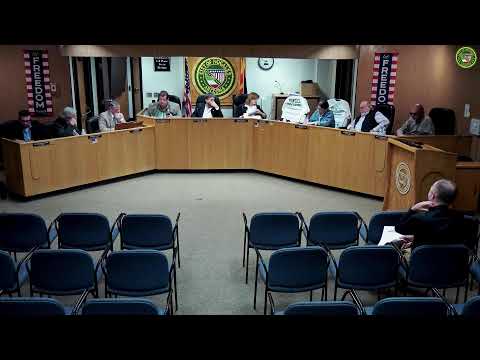
At a May 6 council meeting, Nogales police and local social‑service leaders described a coordinated, resource‑linking approach to people experiencing homelessness and offered figures that illustrate both need and capacity constraints.
Nogales Police (presented by Mr. Jimenez) said the department does not maintain policies that specifically target people experiencing homelessness and instead enforces laws uniformly while prioritizing welfare checks and referrals. "The Nogales Police Department responds to persons experiencing homelessness. We do not provide shelter housing programs. Instead, our role is more about public safety, outreach, and connecting people to services," Mr. Jimenez said.
Ryan Quick, health and social services manager at Mariposa Community Health Center and chair of the Santa Cruz County Local Coalition to End Homelessness, described coalition efforts to coordinate regional providers and use a vulnerability scoring process for HUD‑defined homelessness. Quick said the coalition’s latest point‑in‑time count identified 17 people living in cars, uninhabitable spaces or on the street, and that Mariposa and partners logged 358 contacts in 2025 and made 217 outgoing referrals to other agencies. "Recently we did have one voucher available and we were able to house a gentleman who had been homeless due to a medical condition," Quick said, noting that vouchers are scarce and the coalition uses a scoring process to allocate them.
Council members asked about shelter capacity, veterans’ services and seasonal fluctuations; staff and coalition leaders said Crossroads Mission serves as a local shelter partner, Hope Inc. provides outreach and recovery support, and VA coordination exists for veterans. Quick also told council the coalition had six people complete the vulnerability survey in a recent period and cited transportation assistance and peer‑support referrals as frequent needs.
The council did not take legislative action but supported continued coordination; staff noted ongoing efforts to seek additional funding and to make training, outreach and referral pathways more consistent. Council members urged outreach persistence because many individuals decline services at first contact.
Next steps: coalition and city staff will continue case conferencing for coordinated entry, pursue grants that could offset program costs, and report back to council on capacity and voucher availability.