Get Full Government Meeting Transcripts, Videos, & Alerts Forever!
Get email alerts on the Housing Affordability topic
No spam. Unsubscribe anytime.
Alameda planning board opens study on allowing ADU condominium conversions
Summary
At a May 11 study session, Alameda planning staff outlined options to allow proposed or existing accessory dwelling units (ADUs) to convert to condominiums, citing state law changes and asking the board for policy direction on tenant protections, setbacks, multifamily conversion caps and fees.
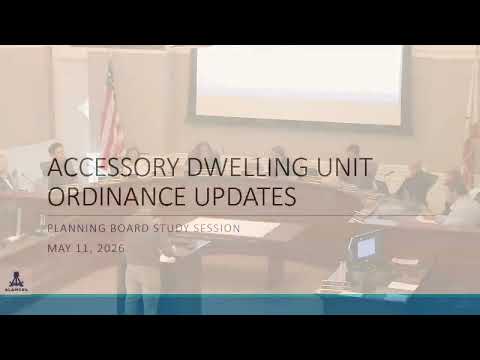
Staff presented a study session May 11 on proposed amendments to Alameda’s accessory dwelling unit (ADU) ordinance that would, if adopted, let homeowners convert proposed or existing ADUs into condominium units for separate sale.
The presentation, given as a non‑decisional study session, framed the question around AB 1033 and several other recent state laws. "AB 1033 is kind of maybe one of the more consequential ones," the presenter told the board, noting that statewide‑exemption ADUs governed by Government Code section 66323 would remain exempt from many local development standards.
Why it matters: allowing condo conversions could expand ownership pathways in a high‑cost market, but board members and staff flagged the risk that sales could reduce the city’s rental supply or displace tenants. Staff said their analysis shows that converting every existing ADU would represent less than 3% of Alameda’s rental housing stock, a figure they characterized as unlikely to materialize in practice.
What the board discussed: members pressed staff on three implementation areas: (1) whether state law limits local conditions such as minimum lot size or development standards; (2) how SB9 subdivisions and condo conversions would interact; and (3) tenant protections or deed‑restriction tools the city could employ. Several members favored allowing conversions as an option while preserving guard rails. "I kind of favor requiring the same setback as the primary structure," said Board member H, arguing for preserving neighborhood character when ADUs are sited in front yards.
Staff underscored tradeoffs: converting ADUs to ownership could encourage more ADU construction by raising the potential return to owners who do not want to manage rentals, but it could also, in theory, divert some new units away from the rental market. Board members suggested the city consider targeted safeguards, such as right‑of‑first‑refusal concepts or thresholds for large projects that warrant additional review.
Other technical issues covered in the session included whether to codify a front‑yard setback for non‑exempt ADUs (staff proposed applying the same setback as the primary structure in many cases), how to treat conversions in multifamily buildings (Alameda currently allows uncapped conversions of existing interior space, which exceeds state minimums), and how to handle conversions that replace on‑site parking (staff asked to codify current practice requiring curb‑cut removal when conversions eliminate functional on‑site parking).
Public reaction: two in‑person commenters urged the city to adopt an opt‑in conversion path. Benjamin Winter, who said he has pursued lot splits and ADU projects, told the board condominium conversion often represents the only affordable ownership route for families. Hank Hernandez, president of Alameda Tiny Homes, urged clarity for builders and suggested the city survey existing ADU uses and plan for utility connection issues for purpose‑built conversion units.
Next steps: staff said it will return with a redline ordinance and alternatives (for example, keep the city’s permissive approach; adopt state minimums; or adopt an intermediate cap or set of conditions). The board directed staff to analyze revenue effects of any fee changes, confirm state‑law interactions (including detached vs. attached conversion allowances), and provide clearer options on owner‑occupancy, deed restrictions and design‑review thresholds. The item is expected back in late June.