Get Full Government Meeting Transcripts, Videos, & Alerts Forever!
Get email alerts on the Municipal Budget topic
No spam. Unsubscribe anytime.
Bangor City budget workshop centers on $2 million housing capital fund and new housing, code positions
Summary
At an April 29 Bang or City Council budget workshop, staff proposed a $2,000,000 housing capital fund and several new positions—including a housing-rehab coordinator (50% block grant-funded), an urban development officer and a code-enforcement inspector—prompting discussion about timing of hires and use of the city's unassigned fund balance.
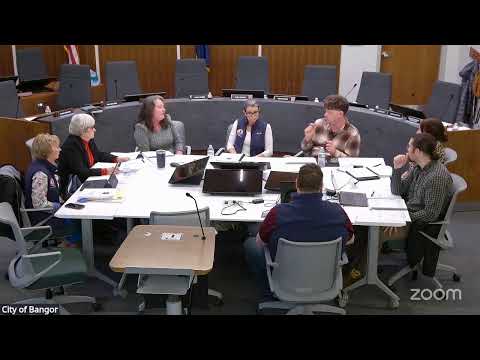
Bangor City held a budget workshop on April 29 in the council chambers to review department program requests and capital priorities, where staff proposed a $2,000,000 housing capital fund and multiple new positions intended to support housing projects, downtown management and code enforcement.
Director Krieg, presenting department highlights, said the planning division will lead a complete rewrite of the land development code this year and that planning also manages the city's climate action plan and grant pursuits. He flagged two major projects for the coming year: the Bangor Central Kitchen and a business retention plan, and described program requests that included digitizing planning files and creating a housing capital fund that had been proposed but not funded in the prior fiscal year.
Why it matters: Staff said the housing fund would let the city invest in private development gaps (land acquisition, permitting support or financing gaps) rather than being tied to a specific unit count. The fund and new staffing requests are planned against an estimated unassigned fund balance that staff said was roughly $25,000,000 at the end of fiscal 2025; the budget on the table would leave nearly $19,000,000 in unassigned balance by March 2026, within a policy target range staff described as $11 million to $22 million.
Details and positions: Director Krieg described several proposed roles: an urban development officer to coordinate downtown work and tourism, a housing rehab coordinator position proposed to be 50% funded from block grant (CDBG) dollars and 50% from the code office, and restoration of a long-unfilled code-enforcement inspector position. On the housing fund, Krieg said, “I chose 2,000,000 as sort of a starting conversation about how much you as the council want to invest,” noting the amount was intended to be a policy conversation rather than a precise projection of unit production.
Council reactions and trade-offs: Council members pressed for clarity on how the housing fund would be used and whether loans (Section 108) or CDBG tools could leverage the city's capital. One councilor urged the council not to delay all action until a future housing committee, saying some matters could move forward now; another asked whether the city could phase hiring assumptions (for example budgeting only a portion of annual salary in year one) because many new positions will not be filled immediately. On the code enforcement request multiple councilors voiced support, arguing enforcement of maintenance and vacant-property rules provides neighborhood benefits and could pay for itself by resolving blight and related issues.
Program and grant items: Staff described a "quality housing provider" program that used ARPA dollars for landlord-facing investments (sprinkler systems, heat pumps) and asked to continue funding. The cultural commission's operating and grants budget was discussed separately; staff proposed using Tax Increment Financing (TIF) to cover part of arts investments after a recent state statute change that allows that use.
Financial context and next steps: Staff noted the budget includes a 3% cost-of-living adjustment and offered to analyze prior years' adjustments to set appropriate baselines. Councilors and staff agreed to provide additional memos and analysis on hiring timing, potential loan leverage, program metrics (for digitization and expected staff-time savings) and criteria for the housing fund before formal budget adoption. The workshop adjourned with follow-up items scheduled and additional budget meetings to refine priorities.
What was not decided: The council did not take any formal votes at the workshop; amounts and positions remain proposals pending further analysis and later budget action.