Get Full Government Meeting Transcripts, Videos, & Alerts Forever!
Get email alerts on the Animal Shelter topic
No spam. Unsubscribe anytime.
Cochise County considers buying Wuka City site for centrally located animal shelter
Summary
Cochise County supervisors reviewed a plan to buy a Wuka City warehouse and convert it into an animal shelter using a $1 million USDA appropriation plus a county match (about $1.9 million), discussed liability and budget limits, and directed staff to bring a resolution for the board to consider on June 2.
County Administrator Sharon told the Cochise County Board of Supervisors at a May 12 work session that staff had identified a Wuka City warehouse and office parcel that could be converted into a centrally located animal shelter and that preliminary grant and appraisal work is complete.
The financing package discussed combines a roughly $1 million congressional appropriation tied to a USDA grant with a county match the board previously set aside; County Administrator Sharon said the independent appraisal placed fair market value at $500,000 while the current owner’s asking price was $400,000. “We can use the grant money to purchase,” Sharon said, adding that the county match could cover closing costs.
Why it matters: speakers said the county currently relies on intergovernmental agreements (IGAs) with Douglas, Wilcox and others to house animals, which creates a service gap on the county’s more populated central side and costs the county about $350,000 a year in IGA payments (Sharon cited roughly $70,000 to Douglas and about $60,000 to Wilcox). Board members said a centrally located shelter could reduce those transfers and improve reclaim rates for owners.
Operational model and partners: Sharon and the sheriff described two acceptable models—county-operated facilities or nonprofit-operated facilities under contract—and said the sheriff has offered to operate the shelter if the county owns the building. The sheriff told the board he was committed to staffing and supporting a modest startup: “You have my commitment. I’m on board 100%,” the sheriff said. Town manager Suzanne (introduced at the meeting as the town manager for “the town of city library”) and other local officials said Wuka City has signaled support and that the town and local animal groups could help with operations, volunteer capacity and fundraising.
Risks and required steps: staff said a formal USDA environmental review will be required before federal funds can be released but reported no immediate red flags from preliminary checks (no known floodplain or historic-site constraints). Board members pressed on liability, insurance and the risk of scope growth; Sharon said the county’s insurance pool is familiar with shelter-related liabilities but that worker’s compensation and property insurance impacts depend on claims experience. Several supervisors urged a conservative startup (for example, beginning with about 20 kennels rather than 40) and strict budget controls.
Budget and statutory constraints: board members repeatedly flagged Arizona’s state expenditure limit as a key constraint. Multiple speakers warned that using county match funds would count against the county’s expenditure limit and could trigger public criticism or the need to seek a voter-approved override. One supervisor summarized the tension as: if the county proceeds, it should buy the property now and grow services slowly to limit immediate budget impacts.
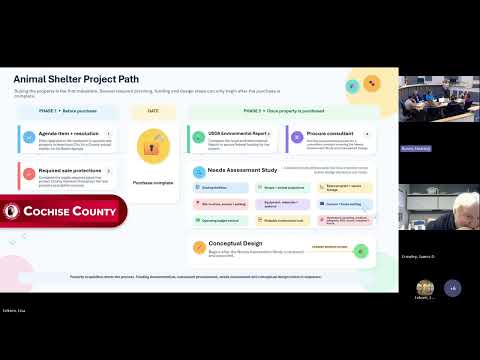
Next steps and timing: Sharon told the board she would return a resolution asking for authorization to acquire the Wuka City property and, if approved, to delegate authority to the county administrator to execute purchase documents; she said she was aiming to present that resolution on June 2. If the board approves acquisition, staff would complete the USDA environmental review, procure design and cost estimates, and work with the sheriff and Wuka City on an intergovernmental agreement that clarifies indemnity, costs and operational roles.
What remains unresolved: no formal action or vote occurred at the work session. Key remaining items include the board’s decision whether to approve the purchase resolution, completion and review of the USDA environmental report, firm cost estimates for upgrades, and negotiation of any IGA with Wuka City and other partners.
The board adjourned and moved to an executive session to consider an unrelated item — approval to enter the national opioid settlement — which officials said could also affect the county’s expenditure calculations.