Get Full Government Meeting Transcripts, Videos, & Alerts Forever!
Get email alerts on the Government Oversight topic
No spam. Unsubscribe anytime.
Senate passes bill creating independent Office of Inspector General for education
Summary
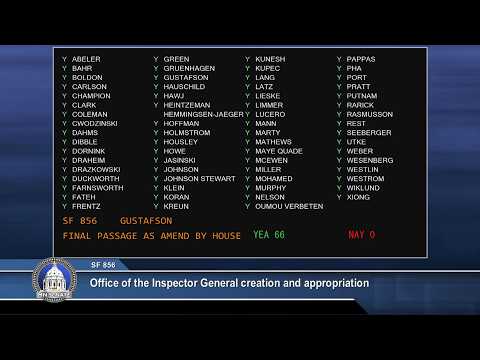
On May 11 the Minnesota Senate approved Senate File 856 to create an Office of Inspector General with a bipartisan advisory commission and reporting requirements; supporters said the bill tightens oversight while critics urged caution about enforcement roles. The measure passed 66–0.
The Minnesota Senate on May 11 passed Senate File 856, establishing an independent Office of Inspector General (OIG) with annual public reporting and a bipartisan advisory commission charged with overseeing investigations of education programs.
Supporters said the bill closes jurisdictional gaps and protects the independence of oversight. "This is not a message bill — we passed it to have something to solve the problem," Sen. Heather Gustafson said on the floor, urging colleagues to approve the House amendments that clarified how an MDE inspector-general would fit within a statewide OIG framework.
Senators described two paths for investigations and enforcement: the inspector general may stand up an anti-fraud and waste bureau, or use agreements with existing agencies to assign officers if a bureau is not created. The bill requires annual public reporting of activities, costs and outcomes, and includes a bipartisan advisory committee; nominees would require a 5/8 vote for confirmation.
Some senators voiced caveats about enforcement authority. "I do have one remaining concern," Sen. John Marty said, supporting the bill while warning that creating a separate law‑enforcement agency inside the OIG could be problematic and that investigative functions should be clearly separated from enforcement.
By voice and roll call the Senate advanced the measure through third reading and final passage; the secretary recorded 66 yeas and zero nays and the bill's title was agreed to. The measure now follows the usual legislative transmission steps for enactment.
The floor debate emphasized bipartisanship in drafting and staff work over the past year, while supporters pointed to tighter guardrails in the House language intended to preserve independence and transparency.
The Senate agreed to the title and passed the bill on final passage.