Get Full Government Meeting Transcripts, Videos, & Alerts Forever!
Get email alerts on the Local History topic
No spam. Unsubscribe anytime.
Historian gives 'cook’s tour' of Moore County history at senior center
Summary
Dr. Matt Fina delivered a public lecture at the Moore County Senior Enrichment Center surveying local history from earliest inhabitants through 1941, highlighting Native settlement, Revolutionary- and Civil War-era events, economic development, Pinehurst’s founding and preservation efforts including the Kenneth Black Cemetery restoration.
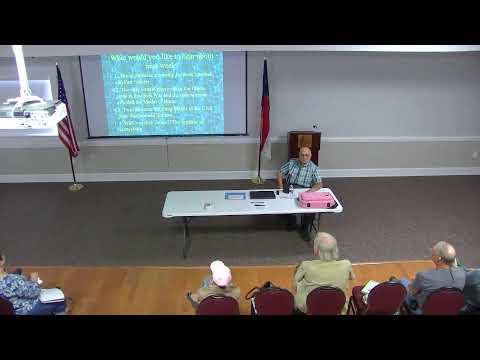
Dr. Matt Fina, president of the Rufus Behringer Civil War Roundtable and a retired pediatric cardiologist, presented a two-part public lecture at the Moore County Senior Enrichment Center on local history, saying the program was “a cook’s tour of Moore County” that would run from prehistory through 1941.
Fina told the nearly full house that archaeological and genetic evidence places the first human arrivals in North America tens of thousands of years ago and that later Woodland-period peoples left pottery and village traces across the region. He traced colonial settlement patterns, the Great Wagon Road migration into the Piedmont, and the creation of Moore County from Cumberland County on July 4, 1784, noting it was named for Captain Alfred Moore, a Revolutionary War figure who later served on the U.S. Supreme Court.
The lecture emphasized local wartime experiences. Fina said Moore County voters narrowly opposed secession in an early county tally (257 against, 139 for) but that the state ultimately joined the Confederacy. He described Moore County volunteer units — Company H of the 26th North Carolina and other companies — and recounted heavy losses at major battles: “Of the 880 officers and men of the 26th North Carolina, 622 had been killed, wounded, or captured in the three days at Gettysburg,” he said. He also reviewed the 1865 campaign movements through the county, including the Kilpatrick–Monroe’s Crossroads engagement and its contested casualty and capture figures.
Fina discussed economic history: mid-19th-century plank roads, coal mining at the Egypt mine (first coal brought up in 1855), and naval-stores production from longleaf pine. He described postwar industry and late-19th-century development, including James W. Tu’s creation of Pinehurst as a planned resort community and the area’s marketing to northern visitors.
The talk also highlighted local preservation efforts. Fina credited the Moore County Historical Association for restoration projects, including the Kenneth Black Cemetery cleanup (the site remains owned by the Black family) and stewardship of historic structures such as the McClendon cabin and the Bryant house. He invited attendees to visit these sites and noted upcoming association presentations on related local battles and cemeteries.
During a short question-and-answer period, an attendee asked whether “the real Confederate flag was always square.” Fina replied that battle-flag shapes varied by theater, explaining that eastern Confederate armies often used a square battle flag while some western units used a more rectangular version.
The program closed with a reminder of future talks and a vote among attendees on which of four topics Fina should present next. The lecture ended with Fina stopping at 1941 — the year he chose to mark as his endpoint — and an announcement of additional appearances and local resources for those seeking deeper research.
Events and resources mentioned include the Rufus Behringer Civil War Roundtable, Moore County Historical Association tours and preservation work, an article on the Kenneth Black Cemetery in Pine Straw magazine, and upcoming talks at the Civic Club and Penn Village. The presentation mixed broad regional background with county-specific details and urged local engagement in archival and preservation projects.