Get Full Government Meeting Transcripts, Videos, & Alerts Forever!
Get email alerts on the Special Education Supports topic
No spam. Unsubscribe anytime.
LAUSD special-education division outlines expanded mental-health supports, parent workshops and training
Summary
Los Angeles Unified's special-education division told the committee it is expanding MTSS-rooted social-emotional instruction, family resource fairs, and paraprofessional onboarding; members pressed for more in-school workshops, wider PD access and clearer referral steps for Phoenix Academy.
Chair Carla Grigo opened the meeting of the Los Angeles Unified School District special-education committee on the importance of mental-health awareness and introduced division staff who presented district efforts to support students with disabilities.
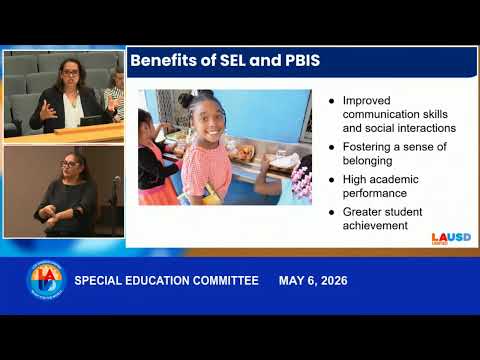
Presenters framed their work around the district's multi-tiered system of supports (MTSS), social-emotional learning (SEAL) and positive behavior interventions and supports (PBIS). Jennifer Nasimento, an instructional specialist in early childhood special education, said those systems are paired with individualized IEP-driven interventions and highlighted family resource fairs, recorded parent workshops and a take-home visual-schedule packet given to families.
The division described several parent and staff resources that it said are available year-round. Erica Garcia, a special-education counselor, outlined the Parent Counseling and Training (PCT) program: weekly virtual sessions offered in English (Wednesdays) and Spanish (Thursdays), 8:30'10:30 a.m., and free virtual workshops for parents of students with IEPs. The panel also played a Spanish-language parent testimonial in which a participant said the sessions helped her better support her child at home.
Behavior-support staff said professional development is available in multiple formats. Elis Lobenstein and David Hajra emphasized a menu of training options: webinars, self-paced modules (including converted functional behavior assessment materials), in-person symposiums and BPART emergency-prevention training that includes a two-day initial session and annual re-certification. The division described a centralized Padlet resource library for school staff to share lessons and tools.
Division psychologist Dr. Jannine Tapalian and Miriam Chow summarized how a tiered MTSS framework guides intervention intensity and explained counseling services that include school-based educationally related intensive counseling (ERIC) and collaboration among psychologists, mental-health providers and teachers. The panel cited evidence-based curricula used across regions, including Zones of Regulation, Ripple Effects and social-emotional resilience curricula.
Committee members praised the expansion of onboarding and PD for paraprofessionals but pressed for broader access and better distribution of information. Jackie Morrow (behavior support coordinator) said onboarding has been expanded regionally and trainings are recorded in the district's professional learning system so attendees can print completion certificates. Members recommended using the district television station (KLCS) for broadcasts, creating liaison roles at school sites, and offering mentorship for veteran paraprofessionals to improve local uptake of the training.
The presentation included a description of Phoenix Academy's therapeutic, small-group model for students with significant social-emotional needs. Staff said Phoenix is referral-based, limited in capacity, staffed by a full-time school psychologist who provides ERIC counseling on-site, and requires parent involvement and case review to ensure it remains a least-restrictive option.
The committee concluded the session by thanking presenters and noting that recommendations from members will be compiled and forwarded to the division and the full board for follow-up.
The committee did not take a formal vote. Next procedural steps identified in discussion were district follow-up on coordination of PD across teachers, principals and paraprofessionals, broader dissemination of training materials to principals and parent centers, and exploration of additional clinical staffing for specialized populations.