Get Full Government Meeting Transcripts, Videos, & Alerts Forever!
Get email alerts on the School Budget topic
No spam. Unsubscribe anytime.
Hoboken board presents 2026–27 budget that raises school-tax levy by $17.45 million (23.6%); vote set for May 12
Summary
At a May public hearing, Hoboken Public School District officials presented a revised 2026–2027 budget that administrators said would raise the school portion of property taxes by $17,450,629 (23.6%), driven by rising health benefits, salaries, charter tuition and enrollment growth; the board will vote on the budget on May 12.
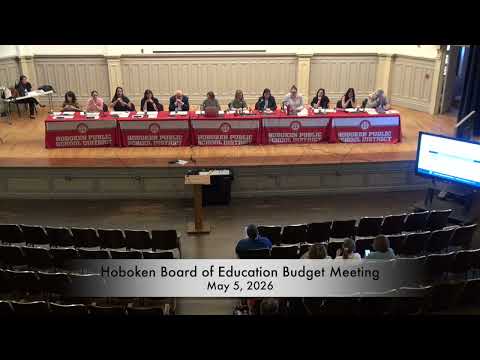
The Hoboken Board of Education held a public hearing on its proposed 2026–27 budget, where district administrators laid out the reasons for a significant increase in the school portion of local property taxes and invited public comment before a scheduled vote on Tuesday, May 12.
Victoria Lopez, the district’s business administrator, said the administration’s revised plan reduces the local tax levy from the tentative figures but still results in a $17,450,629 increase in the school-tax portion — a 23.6% rise on that portion of residents’ property tax bills. The district presented the impact on a home with an average assessed value of $532,600 as an additional $714.59 per year, roughly $1.96 per day.
Lopez described the budget as the district’s complete financial plan for the upcoming fiscal year, noting it reflects months of work and that tonight’s public comments will be part of the public record. She listed a set of line-item adjustments from the tentative budget, including a $2,526,441 reduction in the local tax levy as presented, a $20,000 increase in anticipated pilot payments (to $200,000), a $500,000 reduction in legal-settlement allocations and a roughly $385,999 increase for facilities and custodial maintenance. The presentation also cited staffing reductions and program cuts across several accounts, alongside targeted increases for facilities maintenance and Title I funding.
Why the increase: fixed costs, enrollment and charter tuition
Administrators said the bulk of the increase stems from fixed and state- and contract-driven costs. Salaries were described as the largest single appropriation (representing roughly 43% of total appropriations), while employee health benefits — which the presentation said could jump substantially under statewide trends — were called the single largest driver of this year’s increase. The administration noted an anticipated double-digit increase in state health-benefit premiums and used a conservative estimate in the budget.
The district also reported that payments to charter schools — mandated by state formulas for Hoboken residents who attend charter schools — account for a substantial portion of spending. The presentation cited charter tuition as 14.09% of the overall budget and stated that $14,424,000 in 2026–27 would flow to charter schools; officials said the district does not control that amount.
Enrollment and facilities pressures were another consistent theme. Presenters said district enrollment has grown roughly 53.5% over the past 15–16 years and that elementary enrollment rose by about 75% in that time, leaving several buildings at or above state functional-capacity guidance. Administrators said that growth requires additional staff, instructional materials and expanded program capacity, and that three of five district buildings are more than a century old and overdue for reinvestment.
State aid, restricted funds, and banked cap
District officials explained that while state aid has increased in recent years, much of that money is restricted for preschool and cannot be shifted to general K–12 operating costs. They walked through the School Funding Reform Act (SFRA) framework and the phased adjustments under Senate Bill S2, saying those adjustments produced a cumulative net reduction of roughly $1.82 million over recent cycles for the district’s general operating resources.
Officials also reviewed the local levy cap framework and the district’s use of "banked cap" — unused levy authority from previous years that can be applied for a limited period — describing it as a tool the district can use when fixed costs or enrollment growth exceed the standard 2% cap.
Pilot (PILOT) agreements and the tax base
The presentation highlighted that negotiated payments in lieu of taxes (PILOTs) reduce the portion of assessed value that would otherwise generate school revenue, shifting more of the burden to traditional taxpayers. The administration said it received $200,000 this year from a pilot at 770 Jackson and that a growing share of assessed value in PILOTs effectively narrows the tax base that supports public schools.
Public reaction at the hearing
Four speakers commented during the agenda public-comment period, including two Hoboken city council members who said constituents are struggling under steep combined tax increases across municipal, county and school layers. Councilman Paul Preszano (first ward) said residents reported they often do not know where to find or how to attend board meetings and offered that forthcoming redevelopment in his ward may provide space to relieve capacity pressure. Councilman Michael Russo (third ward and parent) urged the board to revisit major cost categories — particularly healthcare — and explore alternatives to the state plan; he said pilot agreements can be interpreted differently depending on the analytic perspective.
Other community members praised student and staff accomplishments but urged additional scrutiny to reduce the taxpayer burden and cautioned against cutting programs that serve vulnerable students. Manuel Rivera, a sixth-ward resident, specifically said cuts to athletics or supports for students with special needs would cause community concern and urged preserving essential services.
Next steps
Administrators said the full, user-friendly budget documentation will be posted on the district website and that the board will consider a formal adoption vote at its regular meeting on Tuesday, May 12. No formal budget vote occurred at the May public hearing; the meeting concluded after public comment and an adjournment vote.
Quotes from the meeting
"This hearing represents one of the final steps in a budget process that has taken over several months," Victoria Lopez said as she opened the presentation. "All feedback shared tonight becomes part of the public record and helps inform the board's ongoing decision-making."
"Residents are just struggling with the fact that costs are out of our control," Councilman Paul Preszano said during public comment, describing constituent frustration and offering the city's willingness to coordinate on space solutions.
What to watch
- The board vote scheduled for May 12 will decide whether to adopt the proposed budget. - Any changes in state health-benefit rates or state aid allocations prior to adoption could force further adjustments or cuts.
Sources and provenance
This article is based on the board's May public hearing presentation and the public-comment record (board presentation and speakers as recorded in the meeting transcript).