Get Full Government Meeting Transcripts, Videos, & Alerts Forever!
Get email alerts on the Public Safety topic
No spam. Unsubscribe anytime.
Police chief proposes Buckeye ordinance to curb reckless e-bike and e-scooter use
Summary
Police Chief Bob Sanders outlined a proposed Buckeye ordinance to regulate electric bikes, scooters and micromobility devices, emphasizing education-first, mandatory helmets under 18, a proposed age minimum of 16 for higher-speed devices, retailer education and phased enforcement tied to citizen complaints and officer observations.
Police Chief Bob Sanders presented a proposed Buckeye ordinance on May 5 intended to reduce injuries and reckless operation of electric bikes, e-scooters and other micromobility devices.
"Our number one purpose is public safety," Chief Sanders said, framing a three-part approach of education, parental awareness and targeted enforcement if necessary. He told council the department has been studying ordinances from other Valley cities and sought to fill gaps they found in enforcement tools and retailer education.
The chief cited local and national injury trends as a rationale for the rules. He said Buckeye has recorded 32 incidents so far in 2026 (calendar-year) and that national emergency-department data show large increases in e-bike and e-scooter injuries and head trauma since 2020; he attributed an urgent need for awareness and protective measures.
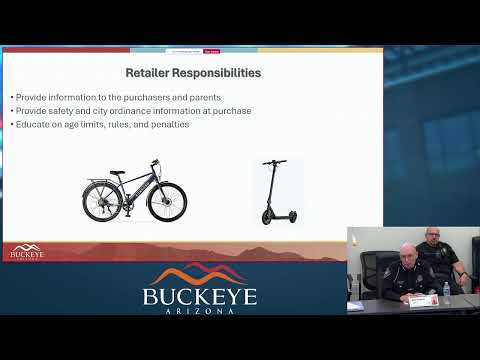
Key provisions staff described include: - Scope: regulate devices designed or capable of exceeding 10 miles per hour (class 1-3 e-bikes, e-scooters and micromobility devices; electric motorcycles/e-motos are treated separately). - Age: staff proposed a minimum operator age of 16 for devices that exceed 10 mph; some council members asked for exceptions when a minor is supervised by a parent and staff agreed to draft clarifying language. - Helmets: mandatory helmet use for operators and passengers under 18, with staff emphasizing proper fit and fastening. - Where to ride: class 1 and class 2 e-bikes and e-scooters permitted in bike lanes and, with pedestrian yield, on sidewalks; class 3 e-bikes and higher-speed e-motos restricted from parks and sidewalks except to cross at intersections. - Parental accountability: ordinance language would allow officers to cite parents (civil citation) instead of juveniles and give officers discretion to engage parents; staff said the intent is to increase parental awareness and responsibility rather than pursue criminal charges. - Retailer duties: point-of-sale education and signage, distribution of pamphlets explaining age limits, helmets, penalties and city rules (modeled in part on existing fireworks display signage requirements). - Enforcement phases: staff proposed a multi-phase rollout beginning with a summer education campaign (June—August), followed by warnings and voluntary compliance, then targeted enforcement based on complaints and officer observations. - Penalties: a proposed civil/municipal schedule (first violation $100, second $250, third $500 plus possible impound; third violation within 12 months could be elevated to a class one misdemeanor for reckless conduct, per staff description).
Chief Sanders said the ordinance will include specific procedures for impound and release of electric motorcycles (which often lack VINs and registration); staff intends to allow owners to prove ownership before release rather than rely solely on motor vehicle records.
Council members asked several operational questions about supervised exceptions, how officers should apply discretion, potential impacts on civil liability and insurance for collisions, and whether the ordinance should explicitly require recklessness to be the enforcement threshold. Sanders said staff would draft clarifying language and add supervisory/guardian exceptions where appropriate.
Timing: Sanders told council the ordinance draft will be revised based on feedback and returned for formal adoption in approximately two weeks, with a public education push planned for the summer before proactive enforcement phases begin.
No formal vote was taken at the workshop; council provided feedback for revisions.