Get Full Government Meeting Transcripts, Videos, & Alerts Forever!
Get email alerts on the Landslide Response topic
No spam. Unsubscribe anytime.
Council extends emergency protections as dewatering and monitoring show progress but higher than baseline movement
Summary
City staff reported that dewatering wells have pumped millions of gallons and that monitored pore pressures and movement rates have fallen since peak winter increases; because key survey points still show significantly greater movement than pre‑slide baselines, council extended temporary access and vehicle restrictions and accepted a financial update on landslide response.
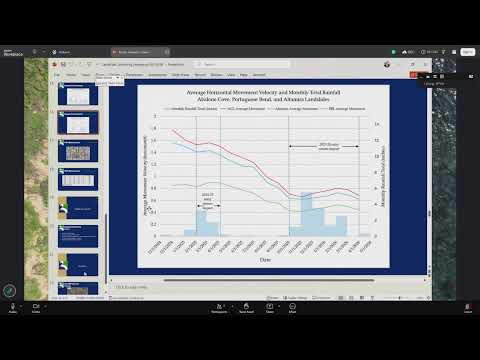
City geologists and staff told the Rancho Palos Verdes City Council that ongoing dewatering and monitoring work have reduced pore pressures and slowed landslide motion compared with winter peaks, but that several locations along the Portuguese Bend‑Abalone Cove complex still move far faster than before the recent phase of acceleration.
Staff reported roughly 18 million gallons pumped in March, and cumulative volumes approaching roughly 1,500 acre‑feet total since operations began. Geologist presentations showed pore‑pressure declines near some deep and shallow slip planes and a month‑to‑month reduction in average displacement rates across the monitored network. "We appear to be seeing more correlation with the shallower slip plane at this time than the deeper slip planes," staff told the council.
Despite these improvements, staff urged continued caution. For six monitored survey points along PV Drive South, current movement rates remain multiple times higher than pre‑activation baselines (one point showed movement roughly eight times greater than October 2022). For that reason staff recommended—and the council adopted—continuing the temporary prohibition on one‑ and two‑wheeled vehicles on PV Drive South and extending emergency protections tied to the declared emergency stabilization project.
Finance staff provided an updated snapshot of landslide‑related spending: the capital program budget for landslide response stands at roughly $64.4 million (covering October 2022–2026 actions); year‑to‑date spend/commitment is approximately $58 million with a projected year‑end spend near $61.5 million. Staff noted grant funding and loans from partner agencies that offset portions of the program. Loans from ACLAD and KCLAD were summarized with scheduled repayments anticipated in late 2026.
Residents testifying from the Grain and other affected neighborhoods described ongoing property impacts, large sinkholes and standing water, and urged the city to prioritize neighborhood repairs and safety mitigation. One resident requested greater attention and funding to repair the localized front‑yard collapse area known as the 'Grain,' and cited nuisance standing water and the temporary winterization infrastructure as impediments to safety and normal access.
Council action: the council voted to receive the technical update, continue the temporary vehicle restrictions and renew emergency measures, and to accept the financial update; staff will continue operational pumping, closed monitoring and provide the hydrology/hydraulics study to council when final (staff expects a draft review cycle with a fall delivery).