Get Full Government Meeting Transcripts, Videos, & Alerts Forever!
Get email alerts on the Land Use Driveway Widths topic
No spam. Unsubscribe anytime.
Planning commission recommends limit on RE-zone driveway widths: 34 ft or 33% of frontage (to 50 ft max)
Summary
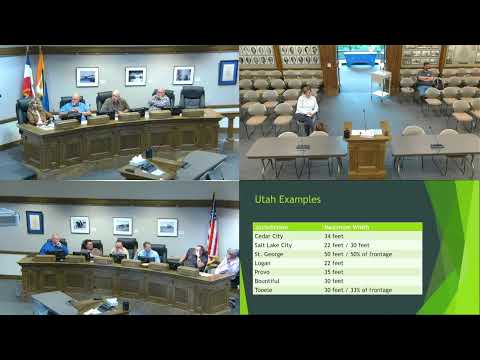
After hearing public comment and staff analysis, commissioners voted to recommend changing driveway-width rules for RE-zoned lots to a standard 34-foot maximum or up to 33% of the lot frontage, but not to exceed 50 feet; the change was confined to the RE zone as advertised.
The Cedar City Planning Commission on May 5 voted to recommend an amendment to the city driveway-width standard for RE (Rural Estate) zoned lots: a 34-foot maximum at the right-of-way line, or up to 33% of the lot frontage, not to exceed 50 feet.
Staff explained that the current residential maximum is 34 feet and that non-residential driveways may be allowed up to 50 feet. The applicant asked to raise the residential limit in RE to 50 feet to accommodate long, straight access to secondary structures and ADUs. Staff summarized common rationales for driveway limits—pedestrian safety, drainage capacity, stormwater infrastructure, snow storage, neighborhood character and predictability—and reviewed how nearby Utah cities handle driveway maximums.
Public commenter Lester Ross asked staff to clarify how driveway width is measured; staff confirmed the standard is measured at the right-of-way line ("top of the apron/top of the slope"). Commissioners debated a proportional approach that ties maximum driveway width to lot frontage versus a flat maximum; several commissioners said a percentage method would better reflect large estate lots while protecting narrow-frontage neighborhoods.
A motion limited to the RE zone (the area that had been advertised for the amendment) was moved and seconded to change the ordinance wording to read: keep 34 feet as the standard or allow up to 33% of the frontage not to exceed 50 feet. The commission voted in favor and the motion carried. Staff noted that applying the change to additional zones would require re-advertising and a broader analysis of curb, gutter and drainage impacts.
The commission’s recommendation will be transmitted to city council for consideration; staff will clarify measurement language in ordinance text to specify measurement at the right-of-way line.