Get Full Government Meeting Transcripts, Videos, & Alerts Forever!
Get email alerts on the Budget Adoption topic
No spam. Unsubscribe anytime.
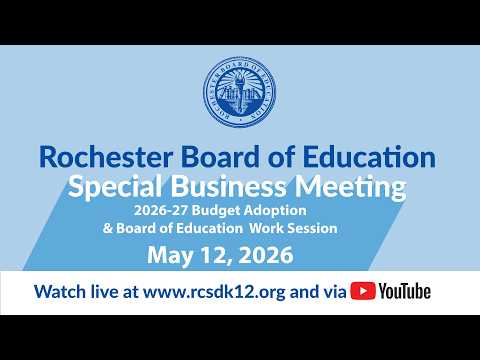
Rochester board adopts $1.2 billion 2026–27 budget after contentious 4–3 vote
Summary
The Rochester City School District board voted 4–3 on May 12 to adopt the district’s roughly $1.2 billion 2026–27 budget after heated debate over program cuts, transparency and potential state intervention; the board approved an amendment to correct line‑item uploads and agreed to revisit a final draft after the state budget is complete.
The Rochester City School District Board of Education voted 4–3 on May 12 to adopt the district’s 2026–27 budget, a plan Superintendent Roser said totals "approximately $1.2 billion" and responds to an immediate shortfall of about $50 million while flagging a potential $61 million gap next year.
Superintendent Roser opened the meeting by asking the board to adopt the proposal, saying the budget is rooted in student supports and long‑term stability: "The budget reflects months of work starting with our community and ending with the board of education and the administration," she said, and asked the board to approve the 2026–27 plan.
Board members spent the next two hours weighing competing priorities and legal timelines. President Simmons emphasized the board’s statutory duty to adopt a budget on schedule and said she had spoken with New York State Education Department leadership about the district’s state‑monitored status and the potential for state action if the board failed to act.
Several commissioners voiced sharp objections. Commissioner Griffin cataloged concerns about contingency staffing language, compliance for home‑hospital instruction, cuts to counseling and psychological services, and a lack of modeling underpinning the district’s long‑range forecast, concluding, "I do not agree with passing this budget." Commissioner LeBron called the plan nontransparent and operationally risky, saying a "no" vote would be an exercise of governance rather than obstruction. Commissioner Santiago said she would vote no, arguing that "mental health support is not an extra. It is not optional."
Other members urged passage to meet the city’s submission deadline and to preserve district operations. Commissioner Feman, identifying herself as a parent and longtime advocate, said she would "vote for an adoption of this budget so that we can move it forward to make sure that we can submit it to city hall." Vice President Malloy and President Simmons also supported adoption, while Commissioner McCulla joined the yes votes at roll call.
Before the final vote, Dr. Roser asked the board to approve a technical amendment correcting line‑item information that had been uploaded from the 2025–26 materials; she said the overall dollar total would not change. Vice President Malloy moved the amendment, seconded by Commissioner Feman; the amendment carried with Commissioner LeBron recorded as opposed.
Commissioner Feman offered a friendly amendment to the adoption motion requiring that the board submit the draft budget to city hall by the May 14 deadline and receive a revised final draft for board deliberation and final adoption once the state budget is finalized. The board approved the budget as amended and with that friendly amendment. Clerk Win then called a roll‑call vote: Commissioner Feman — yes; Commissioner Griffin — no; Commissioner LeBron — no; Commissioner Santiago — no; Vice President Malloy — yes; Commissioner McCulla — yes; President Simmons — yes. The board recorded the adoption by a 4–3 margin.
Chief Scott, speaking later during a connected work session item, described the capital improvement program (Resolution 607) included in the night’s agenda as funding for building repairs, boilers, window and door security work and site projects such as the Loretta Johnson pool and playground upgrades. He said CIP dollars are largely aidable and prioritized by building condition assessments; the board approved Resolution 607 with one recorded opposition.
The board also took first reading of Policy 1400 (the district code of conduct), moved several academic and administrative items (Resolutions 553–573 and 574–604) to the consent agenda for future action, and concluded the work session. President Simmons said the approved draft budget will be submitted to city hall by the May 14 deadline and that the administration will return to the board with a final proposed budget if state revenue assumptions change.
What happens next: the district will submit the adopted draft to the city, and administration said it will present any changes that arise from the state budget for board consideration. Commissioners who opposed the adoption said they intend to continue pressing for greater transparency, additional operational and legal analysis, and protections for special education and mental‑health services.