Get Full Government Meeting Transcripts, Videos, & Alerts Forever!
Get email alerts on the Consumer Confidence Report topic
No spam. Unsubscribe anytime.
Service Director Chris Moore details how Springfield treats water and says the city meets EPA standards
Summary
Service Director Chris Moore summarized Springfield’s annual Consumer Confidence Report, described treatment and testing procedures, said the city meets US and Ohio EPA drinking-water standards, explained usage and capacity figures and confirmed the city’s water is not fluoridated by local voter choice.
Service Director Chris Moore said Springfield meets or exceeds U.S. and Ohio Environmental Protection Agency standards for drinking water and described the city’s treatment process and testing regimen.
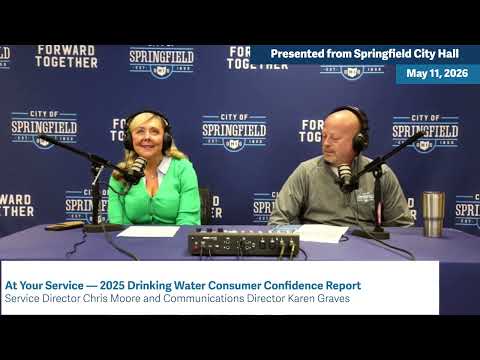
Moore, speaking on the city’s "At Your Service" program, told listeners the Consumer Confidence Report — the annual summary of how the city treats and monitors drinking water — is posted on springfield.ohio.gov and is sent to subscribers via the city newsletter. "We meet or exceed all of the US and Ohio EPA standards for drinking water quality," he said.
The report, Moore said, outlines what is tested and how often. He listed common analytes that residents ask about: lead, nitrates, barium and chlorine. Moore emphasized that the utility has not recorded lead problems in the distribution system and that the city had been on a less-frequent EPA testing regimen for lead because prior sampling repeatedly showed no exceedances. He also noted a separate risk: "service lines that feed people's homes" may contain fittings with lead even when the system itself is compliant.
Moore offered simple precautions for concerned residents: run morning water until it feels noticeably colder to flush water that has been sitting in household pipes. "When I get up in the morning, I have a glass of water. I turn the water on and I let it run until I feel the temperature drop," he said, explaining that the colder temperature signals fresh water from the source is reaching the tap.
On treatment, Moore described Springfield as a groundwater lime-softening plant drawing from the buried Miami Valley aquifer. He summarized the process: soften with lime, coagulate and remove solids, add corrosion-control chemicals and chlorine, then pass water through rapid sand filters, with testing at multiple stages to confirm correct dosing and finished-water quality.
Moore gave operational figures to put scale in perspective: average daily demand is about 9.5 million gallons; the plant routinely treats roughly 18 million gallons of capacity and, for short peak periods when both basins are active, can reach near 36 million gallons. He also noted the large East Main Street water tower holds about 2 million gallons as a visual comparison.
Moore confirmed Springfield water is not fluoridated and said that was decided by local voters. He added the city sells water to Clark County Utilities’ Northridge district, where that utility applies fluoride before distribution to its customers.
The producer encouraged listeners to read the Consumer Confidence Report online or sign up for the city newsletter for a link and further information. Moore closed by clarifying a misspoken technical point on the program — hardness and pH are different measures — and said the program will return next month.
The Consumer Confidence Report and detailed testing results are available at springfield.ohio.gov; residents with questions may contact the service department listed on the city website.