Get Full Government Meeting Transcripts, Videos, & Alerts Forever!
Get email alerts on the Handwriting Digital Literacy topic
No spam. Unsubscribe anytime.
District reviews state cursive requirement and plans digital-literacy scope amid parent concerns
Summary
Committee heard that Section 1511 requires instruction in print, italics and cursive; the district currently covers letter formation (K–2) and third-grade cursive practice, will define the print-to-cursive "joining" element next year, and will develop a K–12 digital-literacy scope that includes AI and responsible use amid parent opt-out interest.
The Wallingford-Swarthmore School District Educational Affairs Committee on May 12 received an update on cursive instruction and the district's emerging digital-literacy scope.
Citing statutory language, the presenter explained that "Section 1511 of the public school code is amended by the act ... establishing new subjects required instruction including print joint italics and cursive handwriting," and described current classroom practice: foundations in K–2 covers letter formation and print; grade 3 uses Handwriting Without Tears with 10–15 minutes of handwriting practice on multiple days.
Mr. Anthony Gabriel said the district currently covers "two of the three" required areas through Foundations and Handwriting Without Tears and identified the remaining item—what he called the "joining" of print and cursive—as the subject of next-year work with elementary principals. He said the district will survey what other districts are doing and define how the joining skill will be taught.
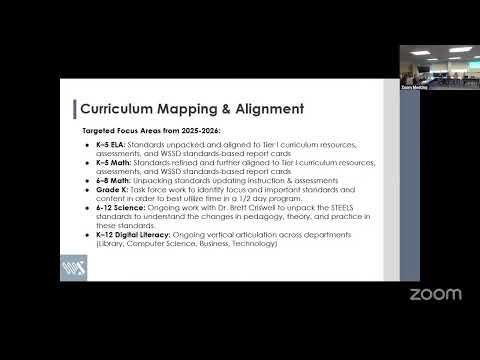
Board members asked about digital literacy: Gabriel said the district intends a K–12 scope that includes digital citizenship, acceptable and responsible device use, safety and security, some exposure to coding concepts and responsible use of artificial intelligence. He said teachers will draw on standards from Common Sense Media, the International Society for Technology in Education and library/computer-science standards to develop a coherent scope and sequence.
The meeting included mentions of community concern: a board member said parents have circulated a sign-on petition to opt children out of some technology use; the presenter said district leaders, including Dr. Johnson and the cabinet, are aware of the concerns and plan a separate community engagement to address them.
Next steps: the district will define the joining element for handwriting and continue summer work on curriculum alignment; a community engagement on technology concerns will be scheduled outside this committee meeting.