Get Full Government Meeting Transcripts, Videos, & Alerts Forever!
Get email alerts on the Housing Development topic
No spam. Unsubscribe anytime.
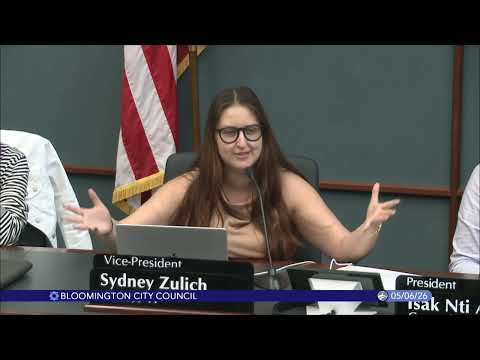
Council approves Hopewell PUD with compromise affordability and energy commitments
Summary
The Bloomington Common Council adopted Ordinance 2026-06 to rezone 6.3 acres as the Hope Planned Unit Development, approving a compromise requiring at least 35% permanently affordable units (goal 50%), specific AMI targeting, and a written energy-efficiency commitment specifying HERS-based performance and high-efficiency systems.
The Bloomington Common Council voted to approve Ordinance 2026-06, rezoning a 6.3‑acre site as a Planned Unit Development known colloquially as Hopewell or Hope PUD. The ordinance passed after hours of debate over permanent affordability targets and technical energy provisions.
Council members adopted a negotiated package of reasonable conditions and a written commitment. The conditions set a floor of 35% of dwelling units to be permanently affordable, with a stated goal of 50%. Of the total, at least 15% must be reserved for households earning at or below 90% of area median income (AMI) and at least 20% for households at or below 120% AMI, according to the compromise language the council approved. The petitioner — the Bloomington Redevelopment Commission — must submit the legal affordability instrument and an implementation framework to the council for review before the first sale or recording of any new instrument.
On energy, the council adopted Written Commitment 1, developed by development staff and the RDC, which requires pre‑approved plans for the PUD to meet an energy performance standard expressed with the Home Energy Rating System (HERS) target (written as a HERS score of 65 or better in the commitment) and to incorporate best‑practice building enclosure and high‑efficiency all‑electric systems where practicable. Council members and staff noted technical uncertainty about how a HERS 65 target compares to state building code baselines (Indiana’s code aligns with the 2018 International Energy Conservation Code in many cases) and recorded a desire for additional verification.
The approval followed extensive public comment and a long council deliberation on tradeoffs: higher affordability percentages would lock greater public benefit into the development but could increase upfront costs or require public subsidy, while lower floors would improve feasibility according to RDC testimony. Redevelopment staff and the RDC cautioned that their revenue source (tax‑increment financing within allocation areas) has a finite horizon and existing obligations that constrain public subsidy capacity. Administration officials also warned against procedural language that would require council review of individual buyer financing packages, citing fair‑housing and operational concerns; legal counsel clarified the adopted language asks for a general implementation framework rather than per‑sale approvals.
The council recorded the adoption of the ordinance and its appended conditions by roll call vote. The PUD package now proceeds to implementation steps led by RDC and administration staff, including refinement of the affordability instruments and energy compliance verification. Council asked staff to report back on implementation progress semi‑annually for five years.
What happens next: the RDC and administration will prepare the final affordability instruments and demonstrate how the chosen mechanisms (silent second mortgages, shared‑equity options, or other tools enumerated in the compromise language) will be used to secure permanent affordability. The council’s written demands aim to ensure transparency and public review before the first affordability instrument is recorded or the first deed is conveyed.