Get Full Government Meeting Transcripts, Videos, & Alerts Forever!
Get email alerts on the Road Embargo topic
No spam. Unsubscribe anytime.
Board approves temporary weight embargo on 220th Street after repeated surface failures
Summary
Citing recurring seal-coat failures and increased heavy-truck traffic near new development, the Woodbury County Board approved a temporary embargo (weight restriction) on 220th Street (County Road from K29 east) and asked the county engineer to remove restrictions if conditions improve.
The Woodbury County Board of Supervisors voted May 5 to place a temporary weight embargo on a 1.22-mile seal-coated section of 220th Street near Sergeant Bluff after hearing that repeated patching had failed to stabilize the roadway.
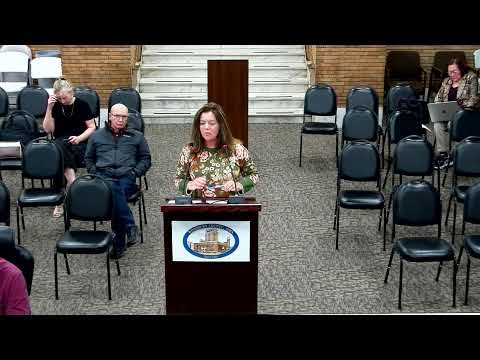
A county roads representative, identified in the discussion as Laura, told the board the thin surface treatment applied in 2017 cannot reliably handle current traffic volumes and heavier triple-axle trucks arriving with construction materials. Laura said crews are spending roughly $30,000 per year patching the stretch and recommended limiting heavy-vehicle traffic while the county evaluates longer-term fixes. “We’re probably spending about $30,000 in patching every year on this road alone,” Laura said.
The embargo resolution describes the affected segment as 220th Street, County Road from K29 east for 1.5 miles to the end of the seal coat, and cites Iowa Code ch. 321, § 471 as authority for restricting vehicle operations by weight. The resolution instructs the county engineer to remove the embargo if road conditions allow.
Motion to adopt the embargo was recorded as moved by Dietrich (transcript records the name as 'Dietri') and seconded by Nelson; the motion passed with no recorded opposition. During discussion board members asked whether the seal coat could be removed and the road returned to gravel; Laura said the county has equipment to do so or could rent it and that the work could happen relatively soon.
What happens next: The county engineer will monitor conditions and remove the embargo when feasible; staff may evaluate resurfacing or reverting to gravel depending on long-term traffic and budget considerations.