Get Full Government Meeting Transcripts, Videos, & Alerts Forever!
Get email alerts on the Museums Culture topic
No spam. Unsubscribe anytime.
Mesa leaders hear $300 million vision to expand Arizona Museum of Natural History into mixed‑use downtown anchor
Summary
City staff and consultants presented a $300 million scenario to replace the museum’s 66,000‑sq‑ft facility with a 118,000‑sq‑ft museum plus hotel, retail and event space, arguing the project would boost visitation, private investment and philanthropic support; council asked for more financial detail and public engagement.
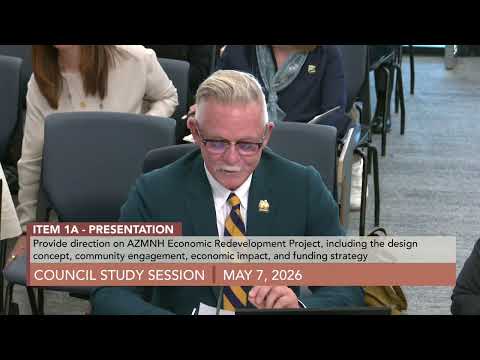
Mesa City Council heard a detailed redevelopment proposal for the Arizona Museum of Natural History on May 14, 2026, as city staff and outside consultants outlined a plan to expand the museum, add commercial amenities and pursue a mixed‑use financing model.
Luis Ruiz, Mesa’s director of arts and culture, opened the presentation by calling the museum “one of Mesa’s most significant cultural assets” and framing the project as part of a broader downtown arts and innovation district. He asked council to consider how the museum could strengthen Mesa “culturally, economically, educationally, and civically.”
Simon Tiffany Adam, director of the Arizona Museum of Natural History, described a vision for a municipally owned museum that functions as civic infrastructure and a regional attraction. “We envision the museum as civic infrastructure,” Simon said, arguing the museum’s collections and research give Mesa a unique story to tell. He told council the current building is about 66,000 square feet and constrains the museum’s ability to grow its audience and revenue; the team presented 118,000 square feet as a right‑sized museum footprint.
Consultants with GNA, Gallagher Associates and Jones Studio laid out how a larger facility could create new earned‑revenue streams — private event space, restaurants, optimized retail and program/classroom space — and catalyze private investment downtown. Spencer Downey, GNA’s feasibility manager, said a mixed‑use option that pairs an 118,000‑sq‑ft museum with roughly 170,000 sq ft of commercial space (hotel, retail, F&B) would substantially increase the museum’s market capture. He cited current attendance of about 175,000 visitors a year and peer benchmarks that show institutions of this scale often draw between roughly 515,000 and 630,000 visitors annually.
On funding, Laura McDonald of the Benefactor Group presented a three‑leg model: (1) public investment, (2) private commercial investment for hospitality and related development, and (3) private philanthropy. Using a $300 million scenario as an example, McDonald said a mature capital campaign would rely on a small number of very large lead gifts plus a broader set of mid‑level and community supporters, and stressed the need to build fundraising capacity and donor cultivation over time.
Presenters described a two‑year preparatory phase the team recommends before any bond or public request: complete an economic impact study, validate site and orientation, develop schematic designs (5–10% level) to be “bond‑ready,” and build the fundraising infrastructure. City staff told council they had identified about $6 million in one‑time city funds over two years to advance those preparatory activities and said the foundation and campaign partners would be asked to supplement that work.
Council members pressed for more detail on several points: the specific breakdown of the two‑year $6 million, concrete case studies and post‑project outcomes for comparable museums, the campaign’s lead‑gift strategy and donor prospects, and annual operating cost modeling if the city were to own a larger facility. Several members also asked that designers study sightlines and orientation so rooftop terraces and observation levels can maximize views of the Superstition Mountains.
Council Member Taylor raised a substantive content concern for the exhibits, asking that the museum represent multiple viewpoints on origins of life and not present a single interpretive framework. Presenters said community engagement and interpretive planning will be used to refine content and that public input will guide exhibit framing.
The project team cited benefits beyond attendance numbers: workforce and STEM partnerships, increased private investment downtown, longer tourist stays and new hospitality demand. Presenters pointed to precedents — such as other museums that moved from constrained facilities into fit‑for‑purpose buildings and successfully increased earned and contributed revenue — and offered to return to council with more comparative data and an economic impact study.
What’s next: the team asked council for direction to proceed into the proposed two‑year preparatory phase. City staff and the museum said they will return with more detailed budgets, a prospect list and economic modeling. The council did not take a final vote on project financing or a bond measure during the meeting; presenters said the next steps would be to build philanthropic capacity and complete feasibility work before any public request.
The study session also included routine administrative items earlier in the agenda and ended with a separate executive‑session motion related to magistrate interviews; a separate procedural motion later placed candidate Jacob Brown on a future council agenda for appointment.