Get Full Government Meeting Transcripts, Videos, & Alerts Forever!
Get email alerts on the Grant Review Process topic
No spam. Unsubscribe anytime.
Baltimore County commission outlines subcommittee review process and recusal rules as applications flood in
Summary
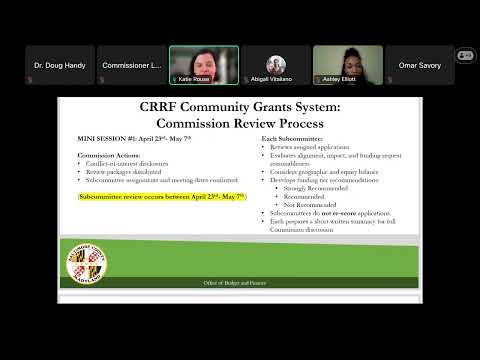
At a working session, commissioners were briefed on subcommittee roles, scheduling, conflict-of-interest disclosure and recusal procedures for reviewing 50+ competitive grant applications; staff said subcommittees gather information and do not vote, and the full commission will vote May 7.
Baltimore County’s Reinvestment and Repair Commission used a working session to set procedures for subcommittee review of more than 50 competitive grant applications, emphasizing transparency, conflict disclosure and a consistent recommendation rubric. Ashley Elliott, the county program administrator supporting the commission, opened the meeting and confirmed there would be no votes at the working session.
Elliott told commissioners that subcommittees are intended to gather information, ask questions and surface issues for the full commission rather than re-score or make final decisions. "For the folks who are in attendance at that subcommittee meeting... everybody who's a part of that meeting is invited to give... to ask questions and share reflections about the information in the applications," she said.
Commissioners raised practical concerns about conflicts of interest after many applicants were recruited by commissioners or have ties to the field. Staff guidance was that any commissioner who discovers a conflict should recuse themselves from the entire review for that application and report the recusal to staff so it can be documented; for virtual meetings that may mean leaving the meeting for that item. Commissioners and staff discussed consistent use of recommendation tiers — "strongly recommend," "recommend," and "not recommend" — as a way to communicate relative priority to the full commission and help the group reconcile high demand with limited funds.
The commission also discussed aggregate funding demand versus an early budget target. Staff reported applicants collectively requested between about $6 million and $10 million; commissioners noted the group previously discussed a target budget of approximately $2.5 million and debated whether award amounts could be adjusted. Staff indicated the county could request updated budgets if the commission recommended funding levels different from applicants' requests.
Subcommittees were asked to finalize meeting dates promptly; staff recommended 90-minute discussion-focused sessions and asked that Ashley, county staff and key commissioners be included on scheduling invitations. The commission will use subcommittee summaries and the county scoring matrix to prepare a packet for the full commission meeting on May 7, where formal recommendations and any voting will occur.
No formal votes or awards were decided at the working session.