Get Full Government Meeting Transcripts, Videos, & Alerts Forever!
Get email alerts on the Local Funding Consensus topic
No spam. Unsubscribe anytime.
Lawmakers weigh restoring county consensus funding, consider formula, eligibility and maintenance rules
Summary
Legislators and local leaders discussed reviving a county consensus grant program that previously distributed about $369 million over a decade, debating distribution formulas, municipal approval thresholds, permissible uses (capital vs. major maintenance) and whether a separate "backs stop" grant should support near-complete projects.
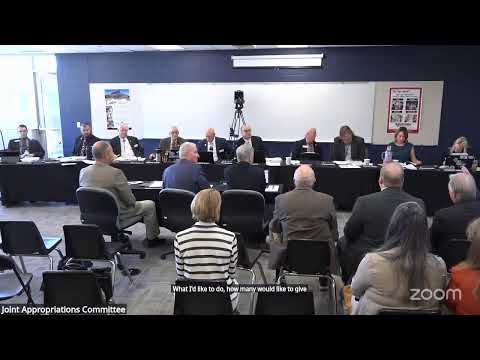
Lawmakers on the Joint Appropriations Committee on May 1 heard officials and local leaders debate whether to restore a countywide consensus funding program that distributed roughly $369 million over a 10-year span.
Don Richards, LSO budget fiscal administrator, told the committee the prior program had no consistent trend in appropriations and averaged about $73.88 million per biennium (not inflation-adjusted). He summarized how the distribution method evolved from a base plus per-capita allocation into a hybrid that combined an 80% per-capita share with 20% distributed by inverse per-capita assessed valuation, intended to steer more money to less-wealthy counties.
Richards highlighted four policy changes embedded in a House amendment discussed this year: using a three-year estimated population average rather than the decennial census; changing the county-level approval rule from 70% of incorporated population to approval by 50% of municipalities in the county; explicitly allowing major maintenance (not only new capital construction); and applying a two-year reversion so unspent funds would revert within the biennium.
"There is really no trend or specific rationale for the amounts per biennium," Richards said, describing how appropriations varied from about $19 million to $190 million in different biennia.
County and municipal representatives urged a single, predictable approach while warning against unintended consequences. Jeremiah Reman, representing Wyoming counties, said countywide consensus "is a good program and allows for communities to make investments in the things that are going to make family-ready communities," and proposed a "backs stop" funding pathway for projects that are close to completion but need a small additional infusion.
Local officials and county association staff pressed the committee for clearer sideboards so funds target infrastructure and essential projects rather than general operating purchases. Beth Blackwell, who works with the city of Newcastle, told the committee that counties often use consensus funds as match for DEEQ landfill closure projects and that OSLI rules (chapter 32) define capital projects, major building repair and routine maintenance differently across applications.
Members discussed how the proposal would interact with existing programs, including the Mineral Royalty Grant (MRG) program, the Business Ready Communities (BRC) program and other water and highways funding streams. Several speakers suggested MRG could function as a backstop for emergencies or near-complete projects, while others urged preserving a separate, locally driven consensus process that gives small communities a voice.
Committee members asked LSO and stakeholders to provide follow-up materials and modeling: (1) examples of past community facilities and MRG-funded projects, (2) funding-model options (trust fund, severance above cap, sales/use tax), (3) proposed definitions/sideboards for permissible uses, and (4) illustrations of how a 50% municipal threshold would operate in counties with many small municipalities.
The committee did not take formal action but directed staff to return with options and modeling to inform a possible bill draft in a future meeting.