Get Full Government Meeting Transcripts, Videos, & Alerts Forever!
Get email alerts on the Middle School Update topic
No spam. Unsubscribe anytime.
Middlesex Middle School principal outlines schedule changes, PLCs and plan to review Chromebook use
Summary
Principal Kate Dumulis told the Darien Board of Education that scheduling fixes and protected PLC time have addressed last year’s uneven class loads, outlined changes to lunches/recess and enrichment, and said the district will review Chromebook and broader ed‑tech practices as part of a five‑year plan.
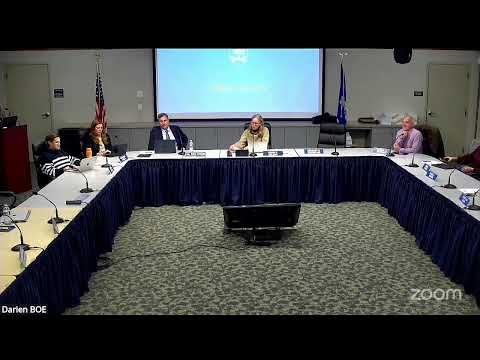
Kate Dumulis, principal of Middlesex Middle School, told the Darien Board of Education on April 8 that a revised team‑based schedule and protected professional learning community (PLC) time have been the building blocks for stabilizing instructional quality after a troubled 2024–25 master schedule.
"My greatest priority was to build relationships and earn trust," Dumulis said, describing monthly team leader meetings, regular collaboration with department chairs and weekly PLCs that guarantee teachers time to analyze student work and align instruction. She said the current structure uses three teams at each grade level, with an extra smaller team in grades six and seven, and that next year’s plan calls for three full teams in grade six, four in grade seven and three in grade eight.
The principal acknowledged those changes may raise average class sizes in places but said the numbers remain within board guidelines and were designed to preserve smaller, team‑based cohorts and consistent supports for students. Dumulis said the schedule also secures a daily flex period for targeted support, and a single grade‑level lunch wave that gives students a mid‑day choice of outdoor recess, indoor library time, an open art studio, study hall or numeracy lab.
Dumulis flagged two next steps. First, she said the district has engaged School Scheduling Associates to undertake a deliberate, data‑driven review of bell times and rotations and that the work will take time: "We started that process with him two weeks ago." Second, she said the school is beginning a review of Chromebook and ed‑tech use. "It’s time for us to look at our use of Chromebooks," Dumulis said, adding that Tim Maguire and the district technology committee are developing a five‑year technology plan to recommend how devices should be used across grade levels.
Board members pressed for specifics. Board member Joanna asked how additional student loads affect teacher prep; Dumulis said teachers report it takes more time but many middle‑school teachers already carry heavier course loads and colleagues have adapted. The board confirmed IDEA enrichment still meets two days a week during students’ lunch period while the district considers schedule adjustments that would shift other elements of a student day.
Tara, speaking from a special‑education perspective, said the department has a designated PLC time this year and has focused on executive functioning, advocacy and coordinated handoffs between grade levels to support transitions from sixth to eighth grade. She said the resource‑room work emphasizes organization and self‑advocacy and that staff are expanding collaboration to smooth year‑to‑year transitions.
Dumulis and board members described student trips, assemblies and enrichment (including a recent visit to the Connecticut Science Center and a planned grade‑8 trip to see Hamilton) as part of a broader effort to build social skills and readiness for larger or overnight experiences in the future.
The presentation concluded with an offer to continue community engagement: Parent University and a spring fireside chat were scheduled in April as forums to discuss executive‑function supports, the vision of the graduate and the emerging technology plan.
The board’s questions and staff responses were discussion items only; no formal policy changes were adopted at the meeting.