Get Full Government Meeting Transcripts, Videos, & Alerts Forever!
Get email alerts on the Humanitarian Safety topic
No spam. Unsubscribe anytime.
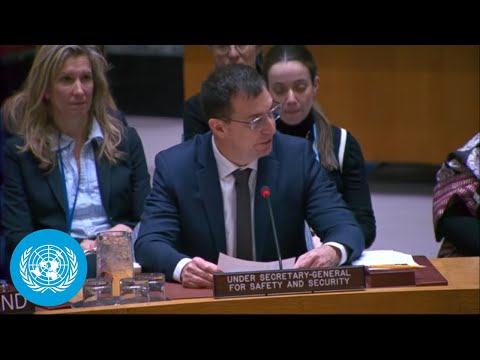
Gilles Michaud urges Security Council to act after rising attacks on U.N. staff
Summary
In his final Security Council briefing, Gilles Michaud warned that attacks on United Nations and humanitarian personnel have increased in scale and frequency, listed recent killings and dozens of injuries, and urged member states to name perpetrators, implement the Secretary-General's recommendations and restore security funding.
Gilles Michaud, speaking in his final briefing to the U.N. Security Council, warned that attacks on United Nations and humanitarian personnel have escalated and called on member states to take concrete steps to protect staff and hold perpetrators accountable.
Michaud recounted recent deadly incidents, saying that "in March of this year in Goma, a drone hit a home killing a UNICEF colleague," that "in November 2025, an Asian colleague working for WHO was killed in Port-au-Prince in an attempted kidnapping," and that "in May of 2024, in Gaza, a tank fired at a UNDSS vehicle killing one of our colleagues and severely injuring another." He added, "to this day, no one has been held accountable for their deaths."
The briefing included updated figures Michaud said reflect mounting harms to U.N. personnel: "Since the last time I briefed you, six UN personnel have been killed. Another 90 have been injured from acts of violence," with national staff continuing to "bear the brunt" of the losses, he said. Michaud also listed 14 abductions, 145 arrests and detentions, 441 acts of intimidation and harassment, 62 attacks on U.N. premises and 84 attacks on U.N. vehicles.
Michaud described systemic pressures on the security system, saying "we have stretched the security system to its limit" and warning that recent budget cuts have forced reductions in security support "from this building to all parts of the world," leaving people and programs more exposed. He urged that without properly resourced security, "life-saving interventions cannot be sustained."
The UNDSS representative criticized both non-state and state actors, saying attacks now "no longer come only from rogue non-state armed groups" but also from member states "who have signed the charter" yet pay limited attention to international humanitarian law. He warned that impunity persists because perpetrators "are rarely held accountable" and are "rarely named and shamed, let alone prosecuted."
Michaud summarized measures UNDSS and partner agencies have taken, including new partnerships, greater use of technology and analytics, increased contingency planning and updated training, but said these efforts are insufficient without stronger political, legal and financial backing. He highlighted operational obstacles that increase risk, such as delayed visas for security personnel, denial of vital safety equipment and ignored deconfliction procedures.
Citing the Secretary-General's 25 November 2024 letter, Michaud reiterated recommended actions: strengthen support to personnel, survivors and victims; embed safety and security considerations in mandates from the outset; and support effective investigations and accountability so attacks "do not go unpunished." He urged member states to sign the declaration for the protection of humanitarian personnel launched at last year's General Assembly and thanked the 122 states that have already done so.
Michaud concluded with an appeal to the Council's conscience, asking when members will "exercise the same moral clarity" and show the courage to protect humanitarian staff. He closed by thanking Mr. Ramesh for his briefing and yielding the floor to Ms. Alice Nicole Moschini.
The briefing contained no formal Council vote or decision; Michaud made a series of policy and operational requests and urged implementation of the Secretary-General's recommendations.