Get Full Government Meeting Transcripts, Videos, & Alerts Forever!
Get email alerts on the Careers Global Health topic
No spam. Unsubscribe anytime.
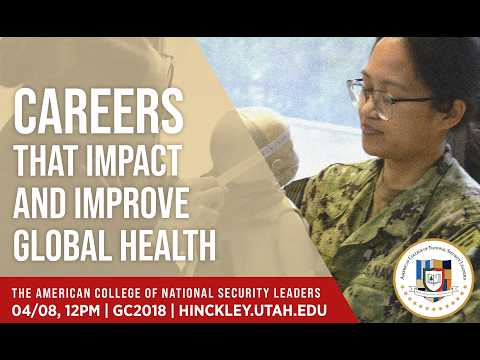
Hinckley Forum leaders urge students to pursue multidisciplinary careers in global health
Summary
At a University of Utah Hinckley Forum, military and academic leaders urged students to build careers that combine clinical skills, public health, veterinary science, engineering and AI, warning climate change and supply-chain strains heighten global health risks.
At a Hinckley Institute forum at the University of Utah, military and academic panelists urged students to pursue multidisciplinary careers in global health, saying the field now demands clinicians, engineers, logisticians and data specialists as much as doctors and nurses.
"Global health is more than that," said retired Lieutenant General Ron Blank, describing the field as work to "optimize and provide a quality of life" and to address social determinants such as air quality, transportation and nutrition. Blank, introduced as the 39th surgeon general of the U.S. Army, outlined four goals in his career: maintaining health, preventing disease, providing routine care and delivering specialized care.
The panel — moderated by Margaret C. "Peggy" Wilmouth, a retired Major General and professor of nursing — included Dr. Ashley Leak Bryant of the University of North Carolina and Lieutenant General Castelaw, a Marine Corps aviator turned entrepreneur. Each described nonlinear career paths that led to work in global health, from nursing and oncology programs abroad to military humanitarian missions.
Dr. Ashley Leak Bryant, senior associate dean for strategy and global affairs, told students to develop "emotional intelligence," integrity and compassion as foundational skills. "Be part of an apprenticeship or preceptorship," she said, urging hands-on training and mentorship.
Panelists tied local climate effects to global risks. In an audience exchange about Utah's low snowpack, participants and panelists warned that drying of the Great Salt Lake, increased dust and wildfires and reduced water for agriculture could worsen respiratory illnesses and food insecurity. "If you don't want to be a doctor, think about what else you can do to support global health," Lieutenant General Castelaw said, noting his company's work on AI-enabled breath and sensor diagnostics to detect pathogens early.
Speakers emphasized "one health" — the interaction of human, animal and environmental health — and highlighted roles often overlooked in public-facing descriptions of health work. Moderator Wilmouth pointed to veterinarians' roles in inoculating animals and inspecting food supplies for military and humanitarian operations.
The forum concluded with practical advice: work hard, volunteer to broaden experience, and take internships such as those offered by the Hinckley Institute and the American College of National Security Leaders. Students were invited to continue the conversation and network with panelists over pizza after the session.
The panel focused on career preparation and system-level threats rather than specific policy proposals. No formal actions were taken at the event; it was a career-oriented public forum for students and attendees.