Get Full Government Meeting Transcripts, Videos, & Alerts Forever!
Get email alerts on the Electric School Buses topic
No spam. Unsubscribe anytime.
PGCPS work group outlines electric school bus roadmap but cites infrastructure, cost and permitting hurdles
Summary
Prince George's County Public Schools staff and board members reviewed a roadmap to electrify school buses by 2040, saying vehicle grants have secured buses but heavy civil upgrades, utility interconnection delays and the loss of some federal incentives have slowed full deployment.
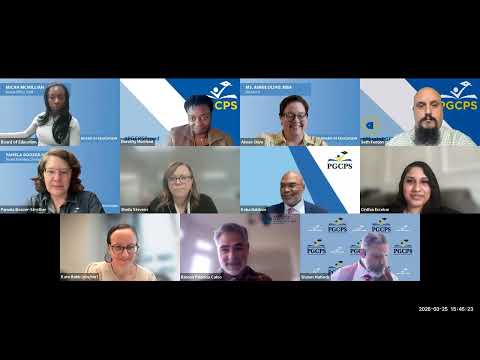
Prince George's County Public Schools (PGCPS) focus work group met March 25 to review five years of planning toward an electric school bus transition, with staff and community advocates emphasizing health benefits but warning that infrastructure, financing and permitting remain major constraints.
The meeting, chaired by the board member serving as committee chair, opened with the group's charge under policy 8100 and a timeline that aims to produce draft recommendations over the summer and bring final recommendations to the board in October. "Our goal is the assessment of where bus electric bus slots and charging infrastructure can be geographically located for maximum route efficiency," the chair said during opening remarks.
Amy Olivo, board member for District 4, described personal and policy reasons for supporting electrification: "I'm a longtime environmental advocate as well as education advocate," she said, noting family experience with bus ridership and indoor-air concerns. Student participant Cynthia Escobar told the group that diesel emissions affect classmates with asthma: "I have a lot of friends that have asthma and they get affected by it," she said, framing health as a primary driver for the work.
Staff laid out the program's origins in advocacy tied to settlement funds and the district's Climate Change Action Plan (CCAP), adopted in 2022, which set a target to electrify the bus fleet by 2040. Dorothy Morrison, director of the Department of Sustainability and Resilience, described DSR's coordinating role across facilities, academics and operations, noting the office is a small team charged with implementing 58 CCAP action items.
Operational and technical details dominated the presentation. Ka Baldwin, director of transportation at Central Garage, said consultants and staff identified a Mullikin bus lot as the initial candidate for a large deployment, including a planned solar canopy and up to roughly 100 chargers. Baldwin said the district also purchased a stopgap set of mobile chargers — "one Level 3 and three Level 2 mobile charging trailers" — but that those trailers relied on propane-powered engines and presented siting constraints.
Sean Matlock, director of the Office of Alternative Infrastructure Planning and Development, presented cost and financing challenges. He gave lifecycle and up-front figures for planning purposes: "A diesel bus usually runs roughly about $100,000," Matlock said, and "an electric school bus costs around $350,000" up front, which raises the district's capital needs. Matlock said changes in federal financing incentives in 2025 meant some early microgrid-based deployment plans no longer "penciled out," forcing the district to scale back and pursue grid-delivered power with targeted buildouts at two sites to start.
Staff and board members described additional implementation constraints. Utility interconnection and permitting are multi-step processes that can take much longer than the stated 60-day minimum, Sheila Stevens, a DSR program manager, told the group. Stevens said a Maryland law effective in October 2024 directs utilities and the Public Service Commission to accelerate grid resiliency and create incentives for distributed energy resources, but that the district is still contending with permitting windows, supply-chain lead times for chargers and heavy-up timelines.
Practical operations also complicate rollout. Matlock and Baldwin described route and workforce limits: with a shortage of drivers, some district pilot approaches required a driver to operate both diesel and electric buses in one shift or to rotate electric buses across AM and PM routes while another bus charged — an inefficient workaround. Staff said they are redesigning routes to enable midday charging, shorter runs and locate initial buses where environmental-justice screening shows higher exposure.
Board members and presenters discussed alternatives and staging. Matlock outlined studying renewable propane and other lower-emission fuels as gap strategies where electrification is not yet practical, but emphasized the district will present comparative emissions and cost analyses before making systemwide recommendations. When asked, an advocate said he was concerned that some propane tailpipe measures can be as high as or higher than diesel in particular metrics; staff replied they will present a formal comparison at a future meeting.
The meeting closed with a look ahead: the work group will meet April 22, 2026, and staff said that session will present maps showing the first two proposed charging locations, environmental-justice overlays and visual examples of what modernized bus lots and employee facilities could look like. "We're going to bring next meeting our goals to show more visual around what a bus lot looks like today and what it should look like," a board member said.
No formal votes or motions were taken at the March 25 meeting; staff described ongoing RFP activity, site planning and the need to align capital budgets and state funding with phased procurement and construction schedules.
Next procedural step: the focus work group will reconvene April 22 to review site maps, routing visuals and an emissions/cost comparison of interim fuel options versus full electrification.