Get Full Government Meeting Transcripts, Videos, & Alerts Forever!
Get email alerts on the Municipal Budget topic
No spam. Unsubscribe anytime.
Seaside budget committee previews roughly $50.5 million FY2027 proposal; staff urges delay on some tourism spending
Summary
City staff presented a proposed FY2027 spending plan of about $50.5 million, driven by capital projects and funded in part by newly flexible transient lodging tax revenue; councilors and staff flagged major water and sewer needs and a possible 13.6%–20% rise in health insurance costs.
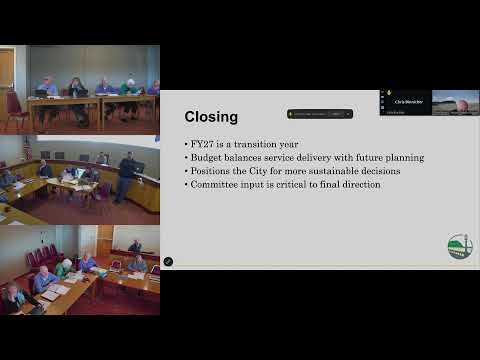
Seaside's budget committee on April 15 reviewed a proposed FY2027 spending plan that staff said totals about $50.5 million (after transfers out), and outlined priorities to address deferred water and sewer projects, street maintenance and park construction.
"The total proposed budget is about $50.5 million," Mr. Kyle, the budget officer, told the committee, noting the increase is largely driven by capital projects rather than day-to-day operating costs. Staff said the proposal maintains service levels without adding net new full-time equivalents this year.
Why it matters: legislation recently changed how some transient lodging tax proceeds may be used. Staff said roughly $182,000 of lodging tax revenue will become discretionary to the city's general fund under the new law; they recommended delaying transfers or projects until Jan. 1, when the statute's timing will allow a negotiated 50/50 allocation to free up more discretionary funds.
"We are going to see an increase of about $182,000 coming to the city," Mr. Kyle said, explaining the city can reallocate some longstanding tourism reserves to streets and parks because of the law change. Staff proposed using available lodging-tax reserves to fund two priorities: North 40 park construction and increased pavement preservation work.
Staff presented competing near-term funding pressures. On personnel costs, city staffers said health-insurance premiums could rise substantially: staff described a roughly 20% increase to retain current plan designs or about a 13.6% increase if the city adopted a scaled-down plan.
"If we want to keep the plan that we have we are looking at a 20% increase," said John Demp, a city staff member who summarized recent CIS (insurance pool) guidance; staff added a reduced-benefit option could lower the increase closer to 13.6 percent but would change employee benefits and could be constrained by union contracts.
Water and sewer were described as the largest long-term capital challenges. Staff outlined a sewer master plan already underway and proposed hiring a consultant to model funding options (rates, debt, grants) and then update projects as the full master plan is completed. Items listed but not fully funded include water-main rehabilitation, a pipe-bridge rebuild, intake access bridge replacement and multiple lift-station generator upgrades.
"We don't necessarily need to wait for the whole master plan to be done to start planning for what project," Mr. Kyle said, recommending an initial funding-and-cost study to inform rate and debt choices.
Other capital priorities in the packet included streetlight conversions to LED (staff cited an estimated payback of about three years and utility rebates), convention-center kitchen and restroom repairs (funded from lodging taxes), a lifeguard tower replacement coordinated with neighboring Canon Beach, and public-works equipment to improve field efficiency.
The committee also discussed a proposal to redirect business-license revenue (now transferred by ordinance to the visitors bureau) back to the general fund while compensating the visitors bureau with additional lodging-tax dollars; staff estimated the shift would yield roughly $400,000 to the general fund and about $580,000 total new resources for infrastructure.
On timing and next steps, staff recommended committee members prepare project-level questions and watch for grant opportunities, especially for water and sewer projects. The packet contains several items marked as "zero" for the current year because funding is not available; staff noted many of those projects are candidates for state loans or grant programs.
The committee scheduled further review of streets and parks project detail, nonprofit grant decisions and facilities/generator funding at its next meeting. The chair recessed the session to reconvene on April 15 at 3 p.m.
What was not decided: the committee did not adopt a final budget at this meeting, and no formal rate change was proposed; staff said the consultant's funding model will inform any future rate recommendations. A motion to add a formal "budget message" to the agenda was approved earlier in the meeting, and the committee elected Kathleen McDonald as chair and confirmed Nancy McHune as secretary.