Get Full Government Meeting Transcripts, Videos, & Alerts Forever!
Get email alerts on the Lead Service Line topic
No spam. Unsubscribe anytime.
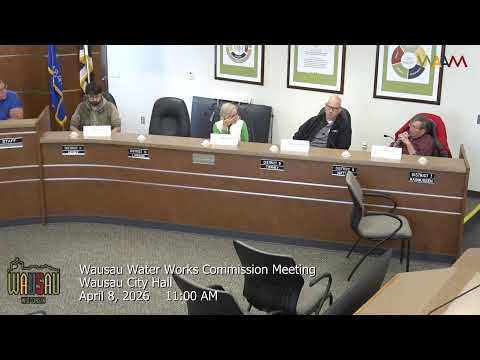
Wausau commission readies lead service-line ordinance as grant aid wanes
Summary
The Wausau Waterworks Commission heard staff say federal and state aid for lead service-line replacements will decline, prompting plans to reintroduce a mandatory ordinance and accelerate inventory and construction work for 2026.
Eric (director) told the Waterworks Commission on April 8 that Wausau is funded for lead-service-line work in 2026 but faces growing costs as principal forgiveness from state programs phases down. He said the utility’s expected borrowing for water work has fallen to about $3.4 million from an earlier $6 million estimate, but private-side replacement costs will rise as forgiveness moves from 100% toward 75% and then 50% in coming years.
“Because this is a mandate, by the end of 2037 we have to have all the lead out of our distribution system,” Eric said, and staff plans to bring a lead-service-line ordinance back to the commission for review before it goes to the city council. He said the ordinance helps scoring on funding applications and could create local processes to use other city revenue sources for replacements, rather than relying on voluntary homeowner participation.
Commissioners and staff noted the utility is starting a hydro-excavation inventory this week and expects pre-construction meetings to proceed so construction can begin in early May. Staff said the utility aims to replace roughly 1,100–1,300 service lines in 2026, contingent on available funding and contractor capacity.
Commission discussion stressed the fiscal challenge of layered regulations and shrinking grant generosity. One commissioner asked whether Wausau could face a doubling of household drinking-water bills based on an AWWA “beyond replacement” estimate; staff said Wausau had already taken a large rate increase in 2023 and expects future increases but not a doubling, in part because the commission and staff have tried to phase investments and pursue available grants.
The commission did not take a formal vote on an ordinance at the April meeting; staff said they will present ordinance language and funding scenarios to the commission and then to the city council in the months ahead. The minutes for March 3 were approved by motion (mover/second not specified in the transcript).