Get Full Government Meeting Transcripts, Videos, & Alerts Forever!
Get email alerts on the Alternative Education Redesign topic
No spam. Unsubscribe anytime.
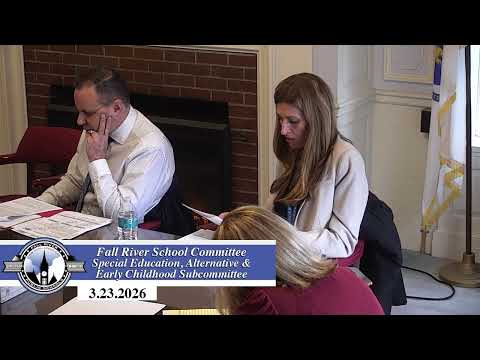
School subcommittee backs referral of RPA redesign plan after questioning on transportation and staff impacts
Summary
A Fall River School Committee subcommittee reviewed a plan to close the current Resiliency Preparatory Academy (RPA) model and replace it with three distinct pathways — an expanded Evolve Academy, the Ascend virtual school, and the Compass afternoon/evening school — and voted to refer the proposal to the full committee provided the administration presents a transportation plan for after-dark programming.
Kenia Soares urged the committee to "reimagine alternative education" and called on Fall River Public Schools to expand pathways for students who do not thrive in traditional settings. Soares delivered the public comment supporting the administration's proposal to redesign the district's alternative-education model.
The administration presented a plan to close the RPA 'in its current design' and replace it with three separate, school-within-a-school pathways housed at an Opportunity Hub at 290 Rock Street: an expanded Evolve Academy, a district-run virtual school to be called Ascend, and Compass, an afternoon/evening program for students with work or family obligations. Dr. B., the assistant superintendent for student support and strategic integration, framed the redesign as a response to longstanding enrollment and graduation challenges at the current model and to steps outlined in a 2021–22 Department of Justice review.
The presenters said Evolve—started in 2019—has grown from 27 students to about 130 and that more than 725 students applied since 2021; Jan Sweitzer, the current Evolve lead, said relocating Evolve to 290 Rock Street would allow the program to expand, reduce a current waitlist and give Evolve an independent school code to support targeted professional development and program visibility. "What began on the first floor of 290 Rock Street in 2019 with 27 students is now a pathway option that serves 130 students," Sweitzer said.
Administrators described Ascend as an in-house virtual school staffed by dedicated teachers using high-quality instructional materials and daily live touchpoints, counseling supports and planned in-person "VIP" appointments for services such as speech or occupational therapy when required. The presenters stated their research and a district survey indicate demand for virtual options and cited rising virtual enrollment trends.
Compass was presented as a 990-hour afternoon/evening pathway that would use block scheduling and micro-credentialing to provide flexible hours for students who work or have caregiving responsibilities; the district said the program would include meals, counseling staff and pathways to credit accumulation that aim to keep students on track for diplomas.
Committee members pressed the administration on operational details that remain unresolved. Questions centered on staffing (class sizes, special-education coverage, and how displaced staff would be handled under contractual rules), graduation rates, and student supports. Administrators said they expect to staff the three pathways with dedicated teachers and administrators and that collective-bargaining issues (notably hours for afternoon/evening staff) would require negotiation with unions such as FREA/FRAA. On special education, the administration said students' IEP services would be preserved and that individualized placement conversations with families would follow once programs are finalized.
Safety and transportation were recurring concerns. Several committee members and staff warned about students leaving at night without reliable rides; presenters said the district would explore late buses, district vans, SRTA partnerships and targeted transportation planning tied to identified cohorts of students. The subcommittee insisted the full committee receive a concrete transportation plan for after-dark and after-school programming before final approval.
Members also raised the Department of Justice review of RPA. Presenters said closing or redesigning the program was one of the DOJ's recommended steps; administrators told the subcommittee the DOJ complaint would be considered addressed if the building and program were closed and reconfigured. The subcommittee asked for a separate update to the full committee on the DOJ matter.
After discussion the subcommittee voted to refer the redesign package to the full School Committee with the caveat that the administration present a transportation plan addressing after-dark and after-school safety and logistics. The subcommittee also voted to request a DOJ update for the full committee. Recorded roll-call notes in the live subcommittee exchange show Mr. Diaz voting yes, Mr. Carr announcing an abstention on the referral motion, and Ms. Turcotte voting yes; the motion moved forward to the full committee for consideration.
Next steps outlined by the administration include preparing a virtual-school application timeline (noted as an April deadline for some state processes), finalizing program-of-study documents through stakeholder planning groups by May, and meeting individually with students and families after School Committee action to confirm placements and transportation needs.