Get Full Government Meeting Transcripts, Videos, & Alerts Forever!
Get email alerts on the Education Grants topic
No spam. Unsubscribe anytime.
OSEP sets May 20 deadline and details FFY 2026 IDEA application changes
Summary
The Office of Special Education Programs told state education agencies that final FFY 2026 IDEA applications are due Wednesday, May 20, and highlighted changes including GEPA Section 427 reporting in the template, an unchanged Build America Buy America requirement, a new optional Part C child-find use for pregnant women, and submission instructions.
An Agency official with the Office of Special Education Programs (OSEP) told state education agencies that the final FFY 2026 Individuals with Disabilities Education Act (IDEA) grant application is due to OSEP on Wednesday, May 20.
The official summarized several important changes and reminders for applicants. "By now, you should have received an email dated May 6th from Al Jones, one of our Associate Division Directors, that provided the 611 and 619 allocation tables for Part B, as well as the file for the Interactive Spreadsheet and the Part C allocation table," the official said.
Why it matters: the updates affect how states report allocations, how they document compliance with civil-rights and procurement rules, and whether they may pursue new optional uses of Part C funds.
Key changes and instructions
GEPA Section 427 reporting: OSEP will no longer collect a separate GEPA Section 427 form. Instead, applicants must provide a GEPA response in the application template (Part B: Section II.A.26; Part C: historically Section II.A.12) describing equitable-access barriers and how they are addressed. "All states submitted GEPA forms. So as far as OSEP is concerned, all states have GEPA documents on file," the official said, and added that states that cannot meet the requirement should contact their OSEP State Lead.
Build America Buy America: The briefing reiterated that the Build America Buy America Act requirement remains in effect. "If you're using federal IDEA funds for construction or broadband infrastructure activities, you have to source your materials from companies in the US," the official said, and directed applicants to read the application memo for waiver information.
Significant Disproportionality and civil-rights section: For FFY 2026 OSEP will not collect Significant Disproportionality information through the Part B application template. The official also pointed agencies to a new Civil Rights Requirements section in the application memo that describes allowable uses of federal funds consistent with federal law and executive orders.
Part B and Part C template details: The official walked through template sections and approval types. Section I asks whether a state seeks full or conditional approval; full approval requires no 'no' responses in Section II, while conditional approval indicates at least one assurance in Section II cannot be met at the time of application. Section III is the use-of-funds section (Part B uses an Interactive Spreadsheet; Part C uses completion of tables). The grant package includes a Grant Memo, the application template and instructions, a Year of Age Cohort attachment for Part B, and policy checklists for Part C.
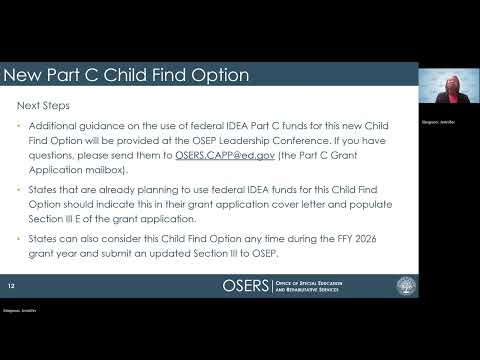
State Incentive Grant and optional Part C child-find: The briefing said the State Incentive Grant will be available to Part C programs that have an Extended Part C Option on file. In addition, 2026 appropriations language allows IDEA Part C funds to optionally support pregnant women expecting a child with a disability; OSEP "will provide additional guidance," and programs may note anticipated uses of funds in Section III or update Section III during FFY 2026.
Instructional materials accessibility: The official reminded Part B agencies they must adopt the National Instructional Materials Accessibility Standards and may coordinate with the National Instructional Materials Access Center (NIMAC). States coordinating with NIMAC must require publishers to send NIMAS files as part of print-instructional-material contracts; states that do not coordinate with NIMAC still must adopt the accessibility standards.
Submission procedures and contacts: Final applications must be emailed from a state government email address as a PDF with an electronic signature or a scanned wet signature. "We may engage in a signature verification process if we are unable to read the signature or identify who the official is that signed the document," the official warned. Questions should be directed to each state's OSEP State Lead; the official also noted OSEP-funded technical-assistance centers as resources.
Next steps: States should ensure Section III is populated with FFY 2026 allocation figures, repost allocation information with application materials on their websites, and indicate in a cover letter if they intend to pursue the State Incentive Grant or the optional Part C child-find use for pregnant women. Applications are due May 20 and must follow the email/PDF/signature instructions noted above.