Get Full Government Meeting Transcripts, Videos, & Alerts Forever!
Get email alerts on the Housing topic
No spam. Unsubscribe anytime.
Evanston commenter asks city to tie CAPER planning to measurable housing outcomes
Summary
John Story Williamson urged the city to explain how planning and policy efforts in the draft 2025 CAPER will produce measurable housing outcomes and how progress will be tracked; city staff said the CAPER covers HUD-funded programs (CDBG, ESG, HOME) and that some pro-housing activities are tracked separately and may not appear yet.
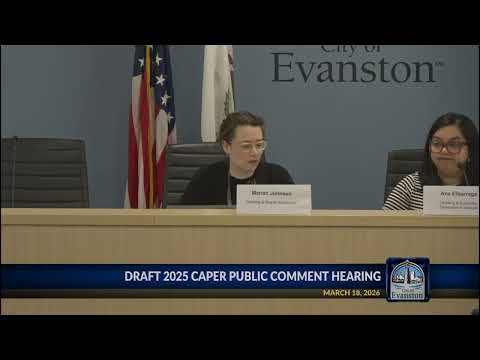
John Story Williamson, a virtual public commenter, urged Evanston officials during a public comment period to explain how planning and policy efforts described in the city’s draft 2025 Consolidated Annual Performance and Evaluation Report (CAPER) will translate into measurable housing outcomes and how those outcomes will be tracked over time.
The request drew a detailed response from a city staff member, who said the CAPER is a performance-evaluation report for specific HUD-funded programs and that other pro-housing efforts are tracked through a separate action-plan process. "The CAPER is a document that provides performance evaluation on the use of the HUD funds that are CDBG ... Emergency Solutions Grant ... as well as HOME Investment Partnership," the staff member said, adding that the pro-housing grant "will have its own action plan" and is not yet submitted to HUD.
Williamson told the meeting the CAPER showed "limited or no completed units and several housing construction and rehabilitation categories" while a large portion of reported activity appeared concentrated in housing code enforcement. "I would ask that the city clearly explain in its final CAPER or related materials how these planning and policy efforts are expected to translate into measurable housing outcomes and how that progress will be tracked over time," he said.
The staff member said some goals in the CAPER were not met because projects that began during the reporting year had not been completed and therefore could not be counted. Using a rental unit rehabilitation as an example, staff explained "projects were started, but we are not able to count them until they're fully completed," and said this timing issue is common in a plan's first year. The staff member also confirmed that written and oral comments will be included in the CAPER submission and provided to the Housing and Community Development Committee and city council prior to any approval.
No other public commenters appeared during the brief meeting, and the staff adjourned after leaving the meeting open for a short period to allow late arrivals. The record shows the commenter’s concern about outcome measurement and staff’s explanation of which HUD programs the CAPER covers; the transcript contains inconsistent references to an exact submission date, so the precise deadline is not specified in the record.