Get email alerts on the Energy Zoning topic
No spam. Unsubscribe anytime.
Monroe County proposes zoning rules for battery storage, excludes small modular nuclear
Summary
Planning staff proposed County Development Ordinance amendments to add conditional standards for battery energy storage systems, exclude small modular nuclear reactors from major utilities, and adjust sidewalk triggers; the text will go to an April 21 final hearing.
Monroe County planning staff presented proposed changes to the County Development Ordinance on April 7 intended to address energy‑production uses and other technical fixes.
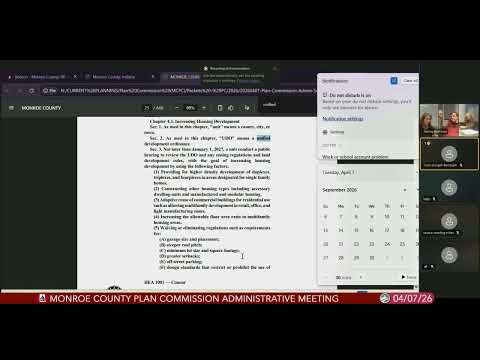
Staff said the discussion was prompted by Senate Enrolled Act 425 and an associated moratorium that ends July 1. The amendments would add conditional use standards for battery energy storage systems in appropriate zones and explicitly state that small modular nuclear reactors (as defined in the draft) are not permitted in the county’s major‑utility classification.
For battery energy storage systems the draft would require an application showing state permitting status and safety coordination, a transportation plan, a drainage plan, visual screening and buffer yards, a noise‑compliance statement, setbacks (staff described a 200‑foot buffer from residential uses and a 50‑foot buffer from other properties as a working standard), and a decommissioning plan. Staff emphasized the county cannot adopt size limits the state preempts, so some dimensions are left to state review while county zoning would address siting, buffering and impervious‑surface standards.
Staff also proposed an immediate correction to sidewalk triggers by removing the 'moderate priority' road category from automatic sidewalk requirements to avoid placing sidewalks in ill‑suited locations; the planning staff said they will revisit the alternative transportation map for longer‑term fixes. Several numbering and definition corrections were also proposed.
The commission agreed to send the text amendment forward for a final hearing on April 21. Staff said they will refine the summary language (including clarifying that small modular nuclear is “not permitted”) and finalize standards and definitions before the hearing.
Next steps: staff will correct draft language, finalize standards and prepare materials for the April 21 final hearing.
AI generated
The text on this page is AI generated. Summaries, highlights, analysis, and video transcripts are all produced from the original source material.
AI can make mistakes, so if you spot one, and we will fix it for everyone.
Note: the source content is unaltered by us. Any content source we link to, be it a video, an audio recording, or a document, is presented exactly as its publisher released it. That publisher is usually a government body, sometimes an individual official or another organisation.