Get Full Government Meeting Transcripts, Videos, & Alerts Forever!
Get email alerts on the Education Funding topic
No spam. Unsubscribe anytime.
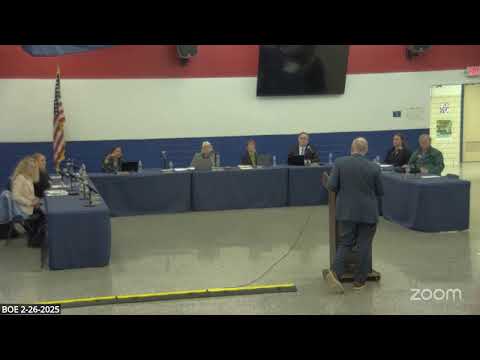
Berkeley Heights board hears referendum plan to replace expiring debt; consultants outline timeline and tax impacts
Summary
Consultants outlined a possible 2026 school capital referendum that could replace maturing debt and secure state Debt Service Aid, reviewed DOE submission timelines and project-selection tools, and answered board and public questions about tax impact, eligibility and solar options. No board decision was taken.
Consultants to the Berkeley Heights School District presented a preliminary plan on Feb. 19 for a possible 2026 capital referendum that would replace expiring district debt and seek State Debt Service Aid, laying out timelines, eligibility rules and likely tax impacts.
The presentation, led by Frank MSO of Solutions Architecture with bond counsel Tony Salamini and financial adviser Danielle Marino of Phoenix Advisers, framed the meeting as an exploratory step: “nothing is set in stone tonight,” MSO said. The team said using the district’s upcoming debt roll‑off could allow the district to borrow without increasing the typical homeowner’s annual payment, depending on the scope and the share of projects that qualify for state aid.
Why it matters: consultants said that projects approved through a referendum can receive Debt Service Aid (the presenters used a conservative planning assumption of about 34% of eligible costs), which reduces the district’s net borrowing and the tax burden. The board must decide whether to finalize a scope and submit conceptual DOE packages by spring and then choose an election date; March 2026 was discussed as a date that could capture debt rolling off, while later dates would lose that timing advantage but allow more time for community engagement.
Key details and recommendations
- Roles and schedule: Salamini, the board’s bond counsel, explained that bond counsel will draft the ballot language and authorize the resolutions that send projects to the Department of Education (DOE). Marino said Phoenix uses conservative interest assumptions (she noted recent deals with interest rates often under 4%) and provides a tax‑impact calculator that homeowners can use to enter their assessed value and see specific estimated changes.
- Project eligibility and priorities: MSO reviewed the district’s prior DOE submission (media centers, STEM/STEAM labs, roofs, parking and mechanical upgrades across several schools) and recommended verifying which items remain, which are complete and which should be removed to lower cost and maximize aid. He said priorities should start with health and safety and building envelope work, paired with visible projects that help public support.
- Timing trade‑offs: presenters emphasized DOE review can take months and that capture of debt roll‑off is time‑sensitive. “If you miss March you’ll miss that debt fall,” a consultant said when discussing how the vote and bond sale must align with the district budget cycle.
Board and public questions
Board members asked about the cost of a special election (presenters estimated roughly $30,000 for a standalone special election), whether mail‑in ballots would be used (yes, rules are the same as other elections), and whether items such as press boxes or athletic field lights would be eligible for aid (press boxes were described as unlikely; lights would require follow‑up). They also asked how useful life of different assets affects bond term (renovations commonly use a ~20‑year term; additions can justify longer terms).
During public comment, teachers and students urged adding solar and energy‑efficiency projects. Anna Karuk, identified as president of the Environmental Club at Governor Livingston, urged the board to “add solar and Energy Efficiency projects” and said existing solar work has saved money. Consultants responded that solar is often pursued through power purchase agreements (PPAs) or other financing vehicles separate from referendum borrowing and that good roof condition is a precondition for rooftop solar.
Next steps
No vote on a referendum was taken. Consultants said they will compile updated cost estimates, verify which past projects remain necessary, prepare DOE conceptual submission materials if the board so chooses, and launch community outreach tools including surveys and a public project‑selection web tool. The board will need to approve any final list by resolution before DOE submission.
The meeting ended after public comment; the board adjourned by voice vote at 8:58 p.m.
Sources: presentation and Q&A at the Berkeley Heights Board of Education special meeting, Feb. 19, 2025. Direct quotes and attributions are taken from meeting remarks by Frank MSO (Solutions Architecture), Tony Salamini (bond counsel) and Danielle Marino (Phoenix Advisers), and from members of the public who identified themselves during the public comment period.