Get Full Government Meeting Transcripts, Videos, & Alerts Forever!
Get email alerts on the Solid Waste Budget topic
No spam. Unsubscribe anytime.
After heated public comments, Skowhegan sets $1 million surplus article; $250,000 reserved for solid-waste costs
Summary
Following extensive public comment and debate over cuts to the solid-waste and recycling budget, the Select Board and budget committee voted to place a $1 million surplus-use article on the June warrant, allocating $750,000 to reduce the tax commitment and $250,000 to offset solid-waste/disposal costs.
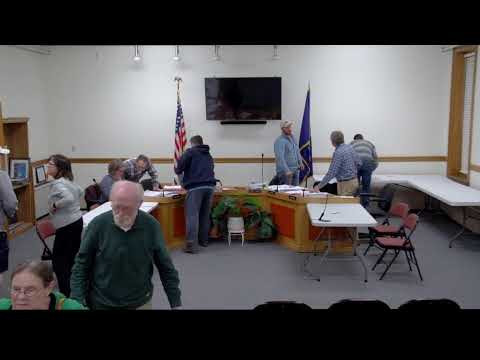
Skowhegan’s Select Board and the town’s budget committee spent a large portion of their May 12 meeting debating cuts to the solid-waste/recycling budget and how to use the town’s unassigned fund balance to soften impacts on taxpayers and operations.
Public commenters warned the board that cutting roughly $250,000 from commercial tipping-fee revenues and the solid-waste budget would shift costs to elderly residents and taxpayers. “You’re penalizing our elderly,” Randy said during public comment, arguing that the change would disproportionately affect residents who cannot haul trash themselves.
Corey, another resident and local business owner, presented town recycling figures and a cost analysis, saying the recycling center operates at a monthly loss: “We currently lose $37,82 a month in the recycling center,” he said while outlining staffing and tonnage numbers. Board members and the department head acknowledged the recycling budget is costly and pointed to new state Extended Producer Responsibility (EPR) laws that are expected to provide reimbursements starting in 2027.
After lengthy debate about fairness, implementation risk and legal constraints, the board and budget committee agreed to place a surplus-use article on the June 8 town-meeting warrant. The resolution on the floor split the $1 million surplus recommendation so that $750,000 would be used to reduce the general-tax commitment and $250,000 would be reserved to offset fiscal-year 2027 solid-waste and recycling disposal costs (subject to voter approval at town meeting).
Why it matters: The transfer-station and disposal line items make up a large, increasing share of the town’s budget because per-ton tipping fees have risen. Town staff warned there is limited near-term wiggle room in the disposal account if the town reduces that operating budget and voters later reject the surplus allocation.
Staff and board members recommended either creating a stand-alone warrant article to restore the $250,000 to solid-waste (so voters can consider it explicitly) or including the $250,000 allocation as part of the surplus-use article, with details explaining how the funds would be split if approved. Budget-committee members argued voters should be given two clear options upstairs — a full $1 million tax reduction or the split with $250,000 for solid-waste.
Quotes and context: Department head Cindy, who runs transfer-station operations, warned that while the town would continue to pursue grants and EPR reimbursements, “our landfills are filling up. That’s something that is pushing every single day,” and said the new EPR law will start reimbursements in 2027.
Next steps: The Select Board approved revised warrant language and will present the surplus-use article with the $750,000/$250,000 split to voters on June 8. The board also discussed adding a separate warrant article specifically authorizing up to $250,000 of surplus for transfer-station disposal costs to give voters a targeted option.
Ending: The May 12 votes moved the surplus debate to the voters and set a path for the town to begin one-time measures to blunt tax impacts while requiring close follow-up on solid-waste management, grant-seeking and EPR reporting.