Get Full Government Meeting Transcripts, Videos, & Alerts Forever!
Get email alerts on the School Budget topic
No spam. Unsubscribe anytime.
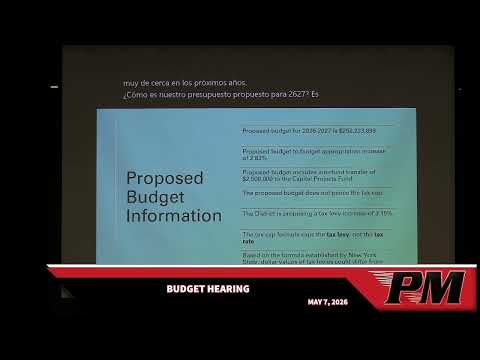
Patchogue-Medford presents $252 million 2026–27 budget, seeks $5M from capital reserve ahead of May 19 vote
Summary
The Patchogue-Medford Union Free School District on May 7 outlined a proposed $252 million 2026–27 budget (2.83% increase), a $2.5 million interfund transfer to capital, and a separate proposition to use $5 million from the district’s capital reserve for building repairs, asbestos remediation and bathroom upgrades; the administration warned of service cuts under a contingent budget if voters reject the plan.
The Patchogue-Medford Union Free School District on May 7 presented its proposed fiscal 2026–27 budget of about $252 million, a budget‑to‑budget appropriation increase of 2.83 percent, and asked voters on May 19 to approve the operating budget and a separate proposition to authorize use of $5 million from the district’s capital reserve.
During a public budget hearing, district presenter Mr. Maisy said roughly 40 percent of the district’s revenue comes from state aid and cited a roughly $300,000 increase tied to universal pre‑K funding that is earned per enrolled child. He warned that a proposed UPK mandate requiring a seat for every eligible child in 2028–29 would create space and classroom bathroom requirements the district must plan for in coming years.
The administration proposed a $2.5 million interfund transfer to capital to fund smaller capital projects without issuing new bonded debt and said it plans to use capital reserve savings (the presentation cited $13.9 million in reserve) for a prioritized slate of projects. The district emphasized that the capital‑reserve proposition is separate from the operating budget vote and that reserve expenditures do not directly change the tax rate because those funds are previously saved monies.
Major capital priorities presented included bathroom repairs (the presentation proposed $1.5 million for bathrooms and ongoing plumbing repairs after higher‑than‑expected emergency costs this year), phased floor‑tile abatement (the district said $1.2 million was spent last year), and an outdoor soil abatement tied to the Bay addition after asbestos was discovered in two stockpiles. The presenter said removing contaminated soil and transporting it to a certified out‑of‑state facility has already cost nearly $600,000 and that the presentation included an estimated $1 million allocation to ensure the Bay addition and abatement can proceed.
The district also proposed modest staffing changes in the operating budget: adding one full‑time business/accounting FTE to support payroll and accounting functions and a maintenance mechanic position to support new unit ventilators and reduce reliance on emergency contractors. The presenter said some prior positions were funded temporarily with federal ARP funds and now need to be folded into the base budget; the district said if voters reject the budget and the board adopts a contingent budget, those new positions and several other items (equipment purchases over $1,500, the $2.5M interfund transfer and targeted administrative/clerical reductions) would be eliminated to achieve roughly $4.2 million in reductions.
On tax impact, the presenter explained the levy and tax‑rate mechanics: the proposed levy increase is just over $4 million (a 3.15 percent levy increase). Because assessed valuations are set by the town later in the summer, the district presented a range for voter guidance. Using a zero decline in assessed values, the illustrative example yielded a 3.29 percent increase for the average home; with a 1 percent decline in assessed value the example rose to about 4.34 percent. The district said the business office will post detailed tax‑impact tables on pmschools.org once final assessed values are available.
Mr. Maisy closed by noting the district’s five‑year financial planning work, projected an estimated unreserved fund balance of about 3.94 percent (the presenter said the state limit is 4 percent), and described proposed transfers into reserve accounts (presentation cited $750,000 to ERS, $250,000 to a TRS‑related fund and $750,000 to capital reserve). He urged residents to review the budget brochure and vote on May 19 (revote June 16 if needed) and said the presentation materials would be posted on the district website for deeper review.
The hearing included audience questions about why Bay’s classrooms or bathrooms were not on the initial list; the administration replied Bay is receiving work as part of the addition and that funds were tentatively allocated to support Bay abatement if needed, but that lower bids might allow advancing other schools’ projects. A motion to adjourn was made and seconded near the scheduled end of the meeting; the transcript does not completely capture a formal roll‑call vote in the record, and the meeting concluded shortly thereafter.
What happens next: Voters decide on the operating budget and the capital‑reserve proposition on May 19; if the operating budget fails the board may adopt a contingent budget that would eliminate identified purchases, transfers and proposed new positions and require staff reductions to meet the contingency targets.