Get Full Government Meeting Transcripts, Videos, & Alerts Forever!
Get email alerts on the Water Quality topic
No spam. Unsubscribe anytime.
Oxnard official presents Channel Islands Harbor water-quality implementation plan, seeks $1 million for Phase One
Summary
Anthony Miller presented Craftwater Engineering's implementation plan recommending Phase One actions across nonstructural, structural and receiving-water strategies for Channel Islands Harbor; he said $3.1 million is secured, $948,164 spent, and staff propose an additional $1 million for implementation and monitoring.
Anthony Miller, special districts manager with Oxnard Public Works' Special Districts Division, presented the Channel Islands Harbor water-quality implementation plan and recommended that the Public Works and Transportation Committee review the Craftwater Engineering report and ask the City Council to direct staff to proceed with Phase One activities across nonstructural, structural and receiving-water strategies.
"Recommendation that the public works and transportation committee review the attached Craftwater Engineering implementation plan and appendices and recommend that the city council direct staff to proceed with phase one activities of selected nonstructural, structural, and receiving water strategies as outlined in table two of the staff report," Miller said.
Why it matters: Miller noted the harbor experienced an algal bloom in June 2018 followed by low dissolved-oxygen levels, and said volunteers from the Channel Islands Neighborhood Council Marine Advisory Committee (MAC) and county and city staff have collected water-quality data that informed the feasibility study and plan. The Craftwater analysis examined 103 mitigation strategies and used a weighted scoring framework to recommend a balanced set of Phase One measures that aim to reduce pollutant loads and improve circulation.
Miller described the plan's organization and scoring. Craftwater and city staff grouped options into three categories'nonstructural (education, procedural changes, maintenance), structural (constructed best-management practices), and receiving-water strategies (measures to increase circulation and reduce residence time). Each strategy was scored on five normalized parameters: water quality and circulation, cost, timeline, implementation considerations and community benefits. Community benefits were used as a filter rather than added to the overall numeric score.
Although the balanced scoring approach guided Phase One selections, Miller said stakeholders consistently prioritized circulation improvements. "In recognition of consistent stakeholder feedback to address circulation as a constituent of concern, a receiving water strategy has been included despite it not being a recommended strategy within the balanced approach," he said, citing further exploration of a passive Edison Canal connection as an example.
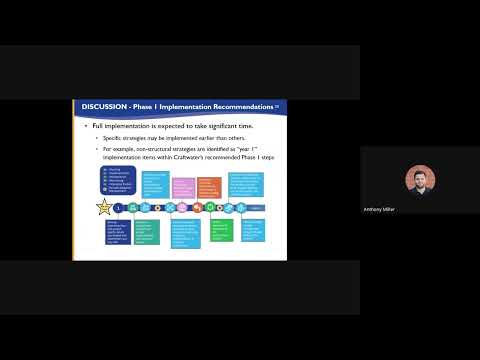
The plan emphasizes front-loading nonstructural actions that are less complex to implement, such as outreach materials, enhanced street sweeping and catch-basin cleaning, illicit-discharge detection and site selection for trash-capture devices. Phase One also includes solicitations for environmental-science services for monitoring design, drainage studies and engineering/design services for selected structural BMPs, and coordination with agricultural landowners at key discharge locations.
Monitoring and adaptive management are core elements: staff plan to establish baseline sampling, set monitoring frequency, compile and analyze data, and use adaptive management to remove or replace strategies found ineffective. Miller recommended partnering with outside testing resources such as the Ventura County Farm Bureau and county laboratories to reduce monitoring costs.
Financials and next steps: Miller said the Craftwater study and implementation plan have been funded by American Rescue Plan Act (ARPA) funds and a California Department of Water Resources grant. "$3.1 million have been secured for water quality related efforts. $948,164 has been spent as of March 6th, 2026," he said, adding that roughly $2.1 million remains dedicated to mitigation efforts and staff's proposed Phase One spending plan would request an additional $1 million.
Miller cautioned that some strategies carry ongoing operations and maintenance costs; for example, construction of measures such as the Wilson Park infiltration BMP would create perpetual maintenance obligations. He also warned that planned receiving-water measures may be limited or removed if regulatory permitting raises insurmountable concerns.
No formal vote or Council direction was recorded in the transcript. Miller outlined solicitations, monitoring work and funding-acquisition steps as the next actions and invited questions from the committee.