Get Full Government Meeting Transcripts, Videos, & Alerts Forever!
Get email alerts on the Historic Preservation topic
No spam. Unsubscribe anytime.
Architect estimates about $700,000 to repair Wilson County courthouse porticoes; county seeks Texas Historical Commission grant match
Summary
An architect told the commissioners court that moisture-related deterioration has caused the courthouse porticoes to delaminate and estimated roughly $700,000 for repairs. The county has applied for an emergency grant from the Texas Historical Commission and will need to budget a local match.
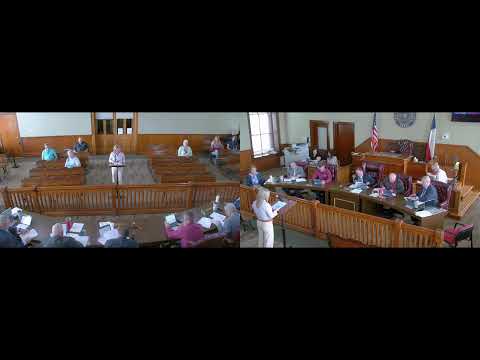
An architect from Thorne Architects told the Wilson County Commissioners Court on May 11 that trapped moisture and failing plaster and reinforcing connections have caused the historic courthouse porticoes to spall and break away, and he offered a repair approach that would reduce recurring water intrusion and extend the elements' life.
"We had it — I ran about $700,000 for all of it," the architect said when asked for a ballpark estimate for removing the decorative balustrades, installing a lightweight membrane roof to shed water, and re-plastering exposed areas. He said the work would preserve the courthouse columns while removing the rooftop "bathtub" that holds water and accelerates deterioration.
County Judge Henry O. Whitman Jr. and the commissioners discussed the application the county submitted last week to the Texas Historical Commission as an emergency grant request. The architect said the state program typically requires a local match; he described past projects where the commission contributed roughly half of eligible costs and recommended the county prepare construction drawings and an RFQ/RFP package to get contractor pricing to refine the budget.
The presentation covered the likely failure mode — moisture migration, freeze/thaw cycling and delamination of plaster and embedded rebar — and a recommended solution that keeps historic columns while reconstructing the roof and upper portico elements in lighter, longer‑lasting materials. The architect said the county should expect follow-up from the Texas Historical Commission within a few weeks as staff review the emergency application and the photographic documentation that the county provided.
Next steps identified by the court included completing construction documents and soliciting bids so the county could determine its exact match obligation and include the project in next fiscal-year budgeting if the grant is approved. No formal vote was required at the hearing; the discussion was marked "discussion only" pending the commission's review of the grant submittal and the contractor pricing.