Get Full Government Meeting Transcripts, Videos, & Alerts Forever!
Get email alerts on the School Transportation topic
No spam. Unsubscribe anytime.
Springfield pilot camera on five school buses finds early violations; administration recommends extension pending grant
Summary
A five-bus stop-arm camera pilot that began April 27 recorded eight automated violations (six likely citations after review). Administration recommends extending the pilot to gather a full year of data and will work with local police on enforcement criteria; a grant application for roughly $50,000 is pending.
Miss Green, chair of the Springfield Township SD Property Committee, said the administration recommends extending a five-bus stop-arm camera pilot so the district can gather a full school year of data before deciding on wider deployment.
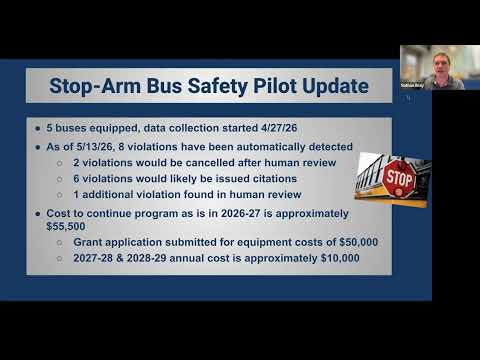
Nate Bray, who presented the pilot results, said automated recordings beginning April 27 produced eight flagged incidents. After human review, Bray said two would likely have been dismissed, while six would likely have resulted in citations. In one multi-vehicle automated recording, police reviewers indicated they would probably have cited two vehicles that passed the stopped bus ‘at the same time’ rather than only the second vehicle.
Bray told the committee the pilot’s vendor experienced installation and software “speed bumps” that reduced how often some buses checked in; the vendor is working on updates and the district expects a possible spike in detected events through June while fixes are applied.
Bray gave a year‑one cost estimate of about $55,500 for hardware and software licensing for the 2026‑27 school year to operate the five buses, with estimated ongoing annual costs of about $10,000 thereafter once hardware is paid, plus a per-violation processing fee the vendor cited (roughly $37 per transaction). He added that district net revenue per paid citation could be roughly $200 after vendor fees (Bray estimated about $1,200 from six paid citations), but cautioned collection rates and Pennsylvania collection procedures could affect that calculation.
Miss Green said the administration submitted an application for a targeted school-bus-safety grant that could cover about $50,000 of the project; grant award decisions are expected in two to three months. She said administration does not yet have formal enforcement criteria agreements with the local police and that the district prefers to work with police and township partners before fully implementing a paid-enforcement program.
Committee members asked about public communications; Bray and other administrators said a joint communication plan with police and township officials would likely be developed if the district proceeds, and that the pilot was intended to cover high-traffic routes where violations are most likely. The committee agreed to revisit the pilot if the grant is awarded and to present any formal proposal to the Property Committee and full board before broader rollout.
Next steps: administration will continue the pilot through the end of the school year if vendor cooperation allows, await the grant decision, and convene police and township stakeholders to define enforcement criteria and communications.