Get Full Government Meeting Transcripts, Videos, & Alerts Forever!
Get email alerts on the Infrastructure Wastewater topic
No spam. Unsubscribe anytime.
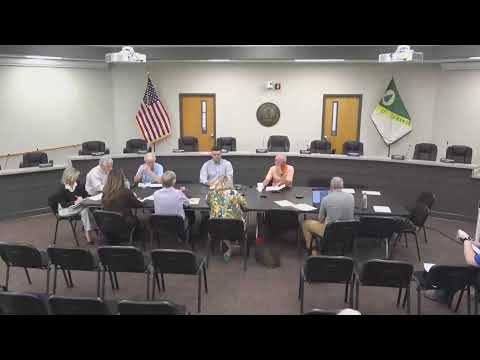
Lebanon panel elects Jeff Baines chair, sets timeline and criteria for wastewater plant site selection
Summary
The Wastewater Treatment Plant Site Selection Committee elected Jeff Baines chair by voice vote, heard a consultant say a new plant typically needs about 60 buildable acres, discussed Rockwood and willing-seller checks, and set a follow-up meeting to review mapped sites and a draft scoring matrix.
Jeff Baines was elected chair of the Wastewater Treatment Plant Site Selection Committee by voice vote during the committee’s meeting; members also selected a vice chair and a secretary by voice acclamation.
The committee’s immediate work is to narrow and evaluate candidate parcels for a future wastewater treatment plant. Consultant Steve Jones told the group that state rules administered by the Tennessee Department of Environment and Conservation (TDEC) require planning once average daily flow reaches roughly 80% of a plant’s permitted capacity and that, for a standard treatment approach with room to expand, the city should look for about “60 buildable acres.” Jones cautioned that parcels with significant floodplain, steep grading or long force-main runs will substantially increase construction cost.
Why it matters: Lebanon’s existing plant, built in 1961, lacks room to expand on-site and the city is approaching the regulatory capacity threshold that triggers planning and design work. Choosing a site that minimizes new parallel force mains and keeps the new facility relatively close to the existing discharge corridor could lower long‑term costs.
Committee members pressed staff to confirm which candidate parcels have willing sellers before spending significant time on sites that could not be acquired. Public commenters also raised concerns: one resident urged the committee to consider acquiring adjacent acreage and another asked how the public will learn of any committee conflicts of interest; staff responded that legal mechanisms require disclosure and recusal of conflicted members.
Consultant recommendations and next steps: Jones said his team will provide maps, pros-and-cons notes and preliminary cost drivers for each parcel so the committee can develop a scoring matrix. Key criteria discussed included available infrastructure (roads, power, gas), floodplain/floodway extent, buildable acreage, and whether the owner is a willing seller. The committee asked staff and the consultant to prepare a packet so members can narrow the list to a smaller shortlist at the next meeting.
Funding and schedule risk: Staff noted part of the project design is funded through an American Rescue Plan (ARP) state partnership grant; the design work tied to the grant totals $1,800,000 and, based on reimbursement rules described to the committee, up to about $360,000 could be at risk if required deliverables are not submitted on time.
The committee tentatively scheduled its next meeting for the 27th at 4:00 p.m. and directed staff to circulate mapped site materials and a draft scoring matrix in advance. The committee is advisory to the city council and will forward its ranked recommendations to council for final decisions.