Get Full Government Meeting Transcripts, Videos, & Alerts Forever!
Get email alerts on the Airport topic
No spam. Unsubscribe anytime.
Airport projects, debt profile and terminal consolidation framed as revenue and airline partnership priorities
Summary
Airport Director Rhonda Hamnierge and Deputy Director Antonio Strong presented a FY27 operating budget forecast of $249.7 million, described a modest net operating change and framed terminal consolidation as a long-term, revenue-generating project that depends on airline support and timing of bond financing; they also flagged increased concessions and parking revenues.
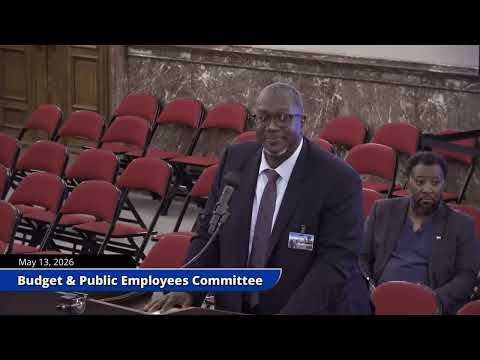
Rhonda Hamnierge, director of St. Louis Lambert International Airport, and Antonio Strong, deputy director for finance and administration, presented the airport’s FY27 operating budget to the Budget & Public Employees Committee on May 13, outlining a $249.7 million revenue forecast and a narrow operating position after proposed adjustments.
Strong said the initial FY27 submission showed a small surplus but subsequent corrections to starting salaries and vacancy factors produced modest changes; the airport plans to propose a budget amendment to adjust the salary-savings (vacancy) factor. "Our original budget request showed that we had a revenue forecast of $249,700,000," Strong said; after adjustments to O&M and debt the net change was modest and the airport will seek an amendment to reflect updated vacancy and salary assumptions.
The presentation highlighted revenue opportunities: an 18% expected increase in concessions revenue as recently remodeled restaurants reopen, a new parking operator and services (including a shuttle-tracking app and a reserved Lot E product), and pledged PFC (passenger facility charge) revenues of about $24.3 million. Strong and Hamnierge said the airport has reduced debt over the past decade to create a window of lower debt service after 2031, which they described as an opportunity to finance a consolidated terminal. "That decrease [in debt service] is something an airline wants to see," Hamnierge said, because airlines pay rates and charges that cover airport debt service.
Committee members pressed for detail on why airlines care about the airport's debt profile, how terminal consolidation would affect fees and how utilities for buildings scheduled for demolition are handled. Hamnierge explained the consolidated terminal's potential revenue gains (a larger garage with more parking capacity and 60% more post-security concessions space) and operational benefits (a consolidated checkpoint and improved connecting flows); she said a realistic completion target for a consolidated terminal would be about 2032, subject to financing and airline partnership approval.
On staffing and compensation, the airport said it continues to evaluate pay-scale issues after the city's wage study and identified airfield maintenance and airfield painter positions as likely undercompensated relative to peer airports; those roles are FAA-required and the airport plans to work with HR and the Department of Personnel to address competitiveness and reduce a roughly 22% vacancy rate in those categories.
The committee did not vote on the airport budget during the hearing; airport staff said they will continue airline negotiations and bring the budget through the city’s FY27 approval process.