Get Full Government Meeting Transcripts, Videos, & Alerts Forever!
Get email alerts on the Streets Refuse topic
No spam. Unsubscribe anytime.
New streets director details staffing cuts, winter response gains and $0 paving allocation in FY27 proposal
Summary
Streets Director James Jackson told aldermen the department will cut about 34.5 authorized positions (mostly vacant), proposed increases for salt, towing and refuse equipment, and requested $12.5M for asphalt materials that the current FY27 proposal does not include; he also highlighted improvements to winter operations and two refuse studies to modernize routes.
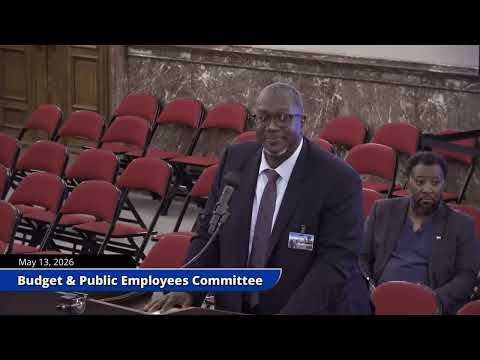
James Jackson, director of the St. Louis City Streets Department, told the Budget & Public Employees Committee on May 13 that the department’s FY27 request reflects both service improvements and tight priorities: the proposed budget increases overall appropriations roughly 4.27% while the department’s table of organization will be reduced from 453 to 418 authorized positions, a cut Jackson said is largely from vacant slots.
"We have 129 vacancies throughout the entire department," Jackson said, noting the department plans to reallocate 34.5 positions and that many of the removed positions were unfilled rather than staffed. Jackson described a string of operational improvements this winter — a 24-hour snow command center with real-time cameras, increased brining and pretreatment, doubled on-call pay for drivers, a QA/QC monitoring component and a residential plowing pilot — and provided season metrics including about 264,500 gallons of brine used, 8,500 tons of salt, roughly 40,965 miles treated and nearly 1,279 completed service requests of 1,660 total (77%).
Jackson outlined division-level budget shifts: a $231,384 increase for lighting poles/controls, $500,000 for signing and striping, an $824,522 increase in towing to fund salaries and the transfer of seven telecommunicators into the towing division, $836,715 added to streets for winter salt and fuel, and personnel increases in refuse to support a new construction equipment operator and a GIS specialist. The department is asking for a $12.5 million asphalt and materials allocation to create a multi-year resurfacing program; the proposed budget currently shows $0 for that request. "If we had those funds available to us, we could set up a formalized street resurfacing and street maintenance program," Jackson said.
On refuse, Jackson and Commissioner Randy Bretonfield described two ongoing studies: the NuGen cart study (examining moving containers from alleys to curbside routes and producing digital route data) and a separate route-digitization study to create and maintain electronic routes. Bretonfield said the department is also managing a deteriorated south facilities garage and anticipates a $13 million transfer station project while seeking longer-term space for maintenance and bulk operations.
Aldermen questioned operational impacts: whether reduced position counts will reduce service (Jackson said no immediate impact because positions were vacant), challenges filling "utility worker lead" roles, equipment backlogs (four vehicles from FY25 remain undelivered), and towing operations (yard capacity ~1,100 vehicles; standard fees $100 tow + $25/day; auctions after 30 days). Aldermen also suggested pilot programs for litter-vacuum equipment; Jackson said the department will consider small pilots funded with ward capital funds.
The committee did not adopt the department’s budget on the spot; aldermen signaled interest in funding targeted capital or program pilots while asking for follow-up detail on costs and service trade-offs.