Get Full Government Meeting Transcripts, Videos, & Alerts Forever!
Get email alerts on the Health Care Workforce topic
No spam. Unsubscribe anytime.
Committee hears HB96 on home-care pay standards and advisory board; providers warn fixed wage mandate could hurt rural agencies
Summary
House Bill 96 would create a Home Care Employment Standards Advisory Board and includes a provision tying a large share of agency rates to direct-care worker pay. Providers urged removing mandatory wage allocations until the advisory board finishes its work; union testimony supported the pay guardrail and Department of Health officials said the federal 80% requirement is being rescinded and cited a Guidehouse rate study calling for a 32% rate increase.
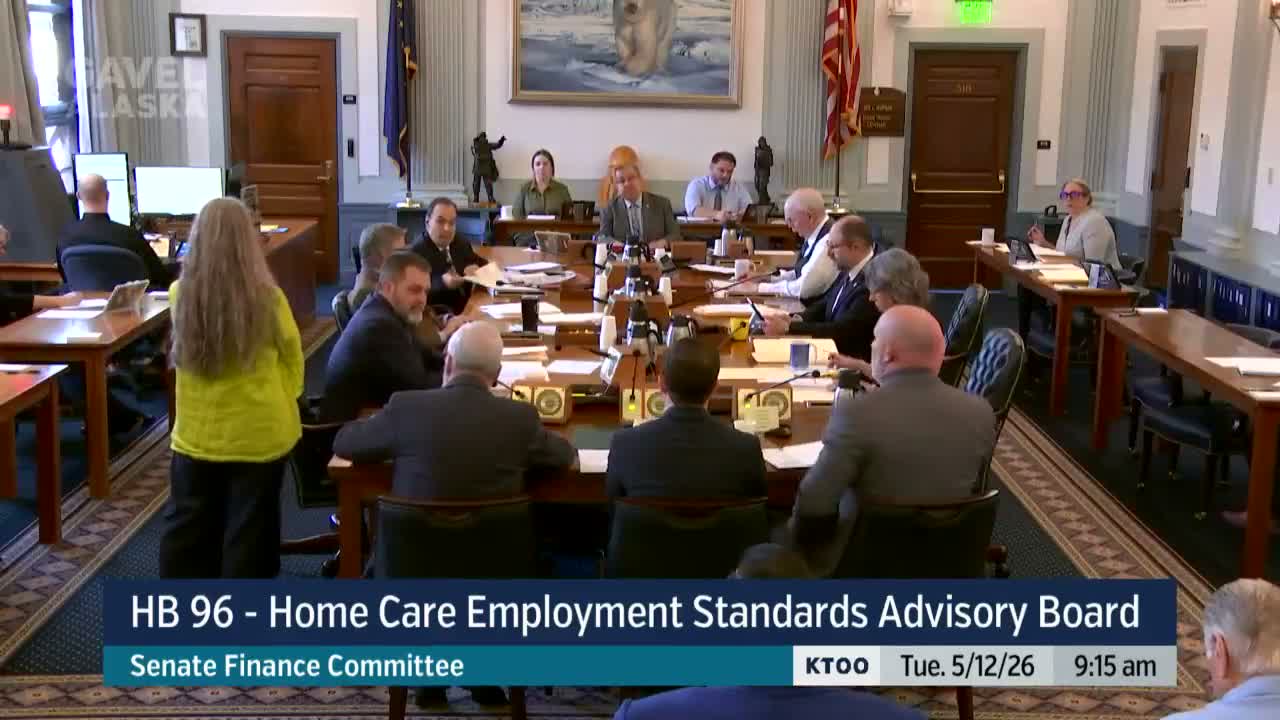
The Alaska Senate Finance Committee heard House Bill 96 on May 12, a proposal to create a Home Care Employment Standards Advisory Board and to set workplace and pay expectations for personal care services agencies. Representative Mike Prox, the bill’s prime sponsor, said the measure responds to a severe caregiver shortage and draws on a Guidehouse rate study to guide policy.
Jen Kimble, executive director of the Alaska Association for Personal Care Supports, told the committee she supports strengthening the direct-care workforce and creation of the advisory board (section 1) but urged removing section 2 because it would impose fixed wage requirements before the new board completes its modernization and rate-assessment work. Kimble said agencies face substantial nonwage operational costs tied to Medicaid program oversight—electronic visit verification, documentation, fraud prevention, supervision and training—and warned that imposing a statutory allocation before regulatory and delivery-system changes are in place could force smaller providers to curtail services, particularly in rural Alaska.
Alexis Sorge, a state director for the caregiver union (SEIU), said the bill’s 80% allocation envisioned for direct-care pay is a guardrail to ensure a meaningful share of rate increases go to frontline workers. Sorge said the bill contains hardship and small-agency exemptions and a multi-year runway for implementation and that union members generally want stable, well-paid agencies rather than employer closures.
Tony Newman, director of the Division of Senior and Disability Services at the Alaska Department of Health, told the committee the federal "ensuring access" requirement that had included an 80% benchmark is being rescinded and that the federal government will issue guidance; as a result, any federal mandate is not currently in effect. Newman said the department’s longstanding regulatory expectation has been that agencies pass roughly 50% of rate revenue toward worker compensation, and he cited the Guidehouse rate study finding that personal care services agencies may need about a 32% rate increase to cover costs. Newman reported there are roughly 13 agency-based and about 55 consumer-directed providers statewide serving approximately 2,300 individuals; he and other officials said regulations would need updating to implement statutory changes and offered to provide additional provider-size breakdowns to the committee.
Senators pressed whether rate increases alone would resolve workforce shortages and how to protect smaller providers; proponents said the advisory board and hardship exemptions are intended to create that nuance. The Department’s fiscal note for HB96 shows an FY27 unrestricted general fund increase of $206,600 and one new full-time position in year one, and a second permanent full-time position in year two (bringing a two-year total to roughly $378,900).
The committee did not take a final vote; the bill remains under committee consideration.