Get Full Government Meeting Transcripts, Videos, & Alerts Forever!
Get email alerts on the Criminal Justice topic
No spam. Unsubscribe anytime.
Prosecutor candidates clash on non‑prosecution, diversion and surveillance at Monroe County forum
Summary
Incumbent Monroe County prosecuting attorney Erica Elephant defended a data‑driven, case‑by‑case approach and diversion programs while challenger Benjamin Arrington campaigned for a progressive approach that would decline prosecution for small marijuana possession, end county 'flock' cameras and expand harm‑reduction policies.
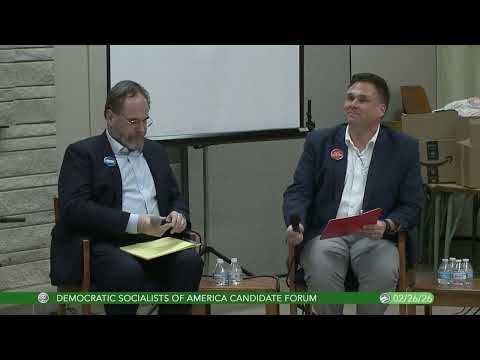
At a Bloomington Democratic Socialists of America forum, Monroe County prosecuting‑attorney candidates debated the scope of prosecutorial discretion, drug enforcement, responses to homelessness and the use of license‑plate 'flock' cameras.
Erica Elephant, the incumbent Monroe County prosecuting attorney, described programs her office has supported during her tenure since 2019: expanding prosecution resources for sex‑crimes and domestic‑violence cases, adding a victim assistant, helping to develop the Stride crisis diversion center, and creating a high‑tech crime unit to process digital forensic evidence across counties. She said her office aims to focus limited resources on violent and repeat offenders and to use diversion where appropriate. “We have a robust diversion program in my office that's been proven to reduce instances of new cases within a year,” Elephant said.
Benjamin Arrington, a challenger who described lived experience with poverty and homelessness, argued for a more explicitly progressive prosecutorial stance. He urged a public policy of non‑prosecution for simple possession of marijuana (one ounce or less), citing Marion County precedent. “Monroe County can and should be a leader for progressive policies in the state,” Arrington said, adding that non‑prosecution is both compassion and practical harm reduction.
The two also sparred over how public declarations affect legal and political risk. Elephant warned that a formal public pledge of non‑prosecution could invite state attention or legislative pushback and said that her office already achieves non‑prosecution outcomes through diversion, dismissals and declinations; she reported roughly 27 pre‑trial diversions and about 30 outright dismissals for marijuana possession in 2025. Arrington said public declarations matter to change practice and public norms and argued that drawing state attention could be worth it to guide policy.
On surveillance and immigration enforcement, both candidates expressed privacy concerns about county‑owned license‑plate readers (six county‑owned cameras were cited). Elephant called for public debate and suggested policies to limit data access, noting law‑enforcement uses in serious cases; Arrington urged immediate removal of county‑owned cameras and framed mass surveillance as disproportionately harming immigrants, people of color and unhoused residents.
Both candidates described support for diversion and re‑entry programs and for harm‑reduction measures. Elephant pointed to the county’s mobile crisis units, the Stride crisis diversion center, problem‑solving courts and community partnerships as evidence‑based tools. Arrington said his office would set a tone of cooperation with defenders and community providers and would prioritize non‑punitive responses for homelessness or substance use.
The candidates closed by naming national and regional progressive prosecutor models they respect and asking for votes ahead of the primary.