Get Full Government Meeting Transcripts, Videos, & Alerts Forever!
Get email alerts on the Restoration Loans Affordable Housing topic
No spam. Unsubscribe anytime.
BRRI credits revolving loan fund and restoration loans with saving Bloomington homes and creating affordable housing
Summary
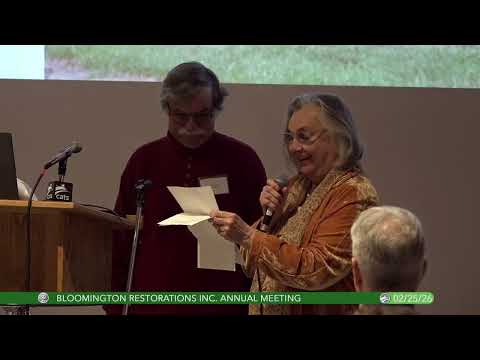
Speakers at BRRI’s 50th anniversary described how a revolving loan fund, restoration loans and covenants helped save at‑risk houses, move structures, and create roughly 29 affordable homes since 1998; presenters recounted the Paris Dunning House salvage and neighborhood fundraising.
Speakers at Bloomington Restorations Incorporated’s 50th‑anniversary meeting described how BRRI’s revolving loan fund and restoration loans enabled salvages, neighborhood revitalization and affordable housing over five decades.
Chris Sturbomb and other presenters traced the movement to the National Historic Preservation Act of 1966 and BRRI’s early use of revolving funds and deed covenants to secure and restore properties banks would not finance. Sturbomb said that the federal law changed the balance between community interest and private profit: “the revolutionary thing about that act was that now law says what a community feels about a historic property matters just as much as the profit that that guy's going to make by tearing it down.”
Duncan Campbell and others recounted the Paris Dunning House project in the early 1980s as a case study: BRRI volunteers and partnered contractors dismantled and rebuilt portions of the shell, followed Secretary of the Interior standards, and relied on community fundraising. Campbell said BRRI aimed for an $88,000 contract in 1983 and that a neighborhood canvass produced $15,000 in cash to help reach the target.
On affordable housing, presenters said BRRI completed its first affordable‑housing project in 1998 and has restored or built about 29 houses through the program. BRRI’s model includes acquiring at‑risk properties, applying preservation covenants, providing restoration consulting, and selecting qualified buyers to ensure long‑term occupancy at low‑to‑moderate incomes. Speakers noted affordability covenants on BRRI projects generally last about 10 years and that many projects used city or state grant funding as part of the financing mix.
Presenters emphasized practical tools — moving houses to fit new lots, filling basements or adjusting structures to meet local codes, and using developer contributions to fund moves — and urged continued cooperation among neighborhoods, the city, and funders to preserve housing stock amid rezoning and density pressures.
The session included audience questions about specific donations (the Paris Dunning House may have been transferred for a nominal fee) and contemporary challenges as new multifamily development replaces older housing in some neighborhoods.