Get Full Government Meeting Transcripts, Videos, & Alerts Forever!
Get email alerts on the Health Literacy Training topic
No spam. Unsubscribe anytime.
NNLM webinar urges plain language and universal precautions to improve health literacy
Summary
In an NNLM webinar, Nick Vera urged communicators to use plain language, universal precautions for health literacy and practical tools (SAM, AHRQ toolkit, MedlinePlus, EthnoMed) to reduce misunderstanding, reach diverse populations and improve outcomes; he answered attendee questions on accessibility and test-result language.
Nick Vera, user experience and education strategist for the Network of the National Library of Medicine (NNLM) Region 2, led a webinar on effective health communication and health literacy, telling attendees the field requires both individual- and organizational-level action.
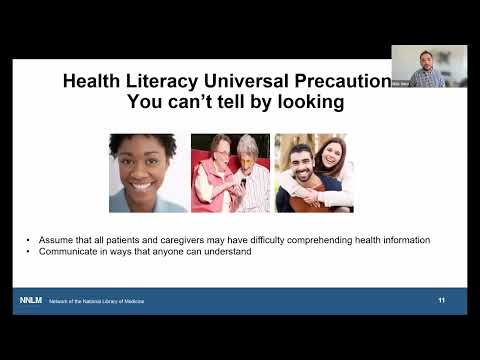
Vera said low health literacy is linked to more emergency-room visits and hospital stays and cited evidence that medication errors affect between 19% and 59% of all medications, arguing that clear communication can reduce those harms. “Applying universal precautions for health literacy means we should communicate in a way that everyone can understand,” he said.
The presentation framed health literacy as a shared responsibility between information providers and receivers and gave practical guidance: use plain language (prefer “stomach” to “abdomen”), limit materials to the need-to-know items (aim for three, five at most), chunk content with descriptive subheadings, use active voice, and confirm understanding with teach-back. Vera contrasted plain-language practices with readability formulas, noting the NIH recommends patient materials be no higher than a sixth-grade reading level but warning that grade-level scores are only a rough gauge.
Vera demonstrated several assessment and content resources. He introduced the Suitability Assessment of Materials (SAM) instrument to score content on categories such as literacy demand, graphics and cultural appropriateness and ran a short group exercise. He highlighted the Agency for Healthcare Research and Quality’s universal precautions toolkit as an evidence-based set of 23 tools for improving written and oral communication, and demonstrated MedlinePlus — the National Library of Medicine’s consumer health site — noting its plain-language topic pages, links to journal articles and ad-free, multilingual content. “MedlinePlus is a great resource,” he said.
The webinar also covered culturally tailored tools: EthnoMed for clinical and cultural profiles of immigrant and refugee groups; Indian Health Service patient-education resources for Native American populations; and practical visual guidance (clear captions, simple drawings, culturally aware imagery and color coding such as air-quality alert colors).
In a live Q&A, attendees asked how to balance accessibility with clinical accuracy when explaining test results. Vera acknowledged differences in tests — for example, higher false-negative rates for some COVID-19 testing windows and distinct concerns for HIV testing — and urged communicators to “take that next step and go through that verbal communication with the patient,” using teach-back to avoid giving false reassurance. He also emphasized accessibility measures such as alt text for images, larger fonts and color contrast to reach people with disabilities.
The session was recorded and will be posted on NNLM’s YouTube channel in about one to two weeks; registered attendees were invited to complete an evaluation to claim continuing-education credit. Vera and Sam Nun (NNLM’s national training office staff) monitored chat questions and shared resource links in the session materials.