Get Full Government Meeting Transcripts, Videos, & Alerts Forever!
Get email alerts on the Wildfire Smoke Child Health topic
No spam. Unsubscribe anytime.
UW study finds Yakima Valley parents report high concern and barriers to protecting children from wildfire smoke
Summary
A University of Washington survey of 199 Yakima Valley parents found about 80% were strongly concerned about wildfire smoke and 70% reported children experienced smoke‑related health problems; researchers are piloting the RISE intervention — air cleaners, masks and education — to boost protective behaviors.
University of Washington researchers say families in Washington State’s Yakima Valley face steep barriers to protecting infants and children from wildfire smoke, and they are testing a community‑centered pilot to deliver HEPA air cleaners, N95 masks and practical education.
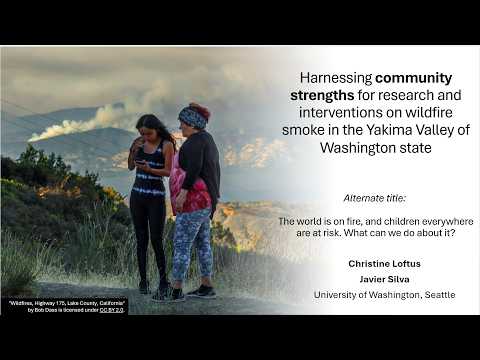
Dr. Christine Loftus, Clinical Associate Professor of Environmental and Occupational Health Sciences at the University of Washington, told attendees of a National Network of Libraries of Medicine webinar that “fire smoke itself causes significant adverse effects on health, even at very low levels,” and that finer particles (PM2.5) can penetrate deep into lungs and reach the bloodstream and placenta.
The study team, led in presentation by Loftus and UW PhD student Javier Silva, surveyed 199 parents in the Yakima Valley between late July and mid‑September 2024 to learn what actions families take during smoke events and what prevents them from doing more. Silva said about 80% of parents expressed strong concern; roughly 70% of respondents reported that at least one child had experienced health problems during recent smoke events, 91% reported at least one symptom (for adults or children), and 60% reported daily‑life disruptions such as missed school or work.
Why it matters: wildfire smoke episodes are increasing and can travel hundreds of miles; Yakima County’s valley geography and local agricultural burning can concentrate PM2.5, the presenters said, leaving farmworker and Spanish‑speaking households especially vulnerable. Silva described the community as having “strong social cohesiveness,” a strength the team hopes to leverage in interventions.
Methods and community partnership: the project combined an online survey with in‑person collection at trusted local hubs — summer meal distribution sites, food banks and health fairs — and partnered closely with Heritage University in Toppenish. The team recruited and trained Heritage undergraduate interns to help with data collection and formed a community advisory board of parents, educators and organizers to guide the study’s priorities and materials.
Findings on resources and predictors: respondents reported being most interested in technical and financial help to obtain indoor air cleaners, instructional videos on how to use devices, and support obtaining and fitting N95 masks. In regression analyses, the strongest predictors of whether parents adopted multiple protective actions were social norms (seeing others in the community take actions) and practical knowledge about how to reduce exposure — not only general awareness of risk.
Student training and local capacity: presenters emphasized the dual aim of producing actionable data and building local research capacity. Student interns used the survey data to conduct their own analyses and present findings; one student said, “I learned that proximity builds trust and data drives action,” and several students were listed as co‑authors on a manuscript under review.
Planned intervention and evaluation: using these results, Loftus described the RISE (Reducing Infant Smoke Exposure) pilot under design: proactive delivery of a portable HEPA air cleaner, N95 masks and targeted educational materials (written and video) to mothers, complemented by timely outreach such as text messages during smoke events. The team plans a randomized trial recruiting mothers through the Yakima Valley Farm Workers Clinic to evaluate whether the package increases protective behaviors, reduces infant smoke exposures and lowers infant respiratory symptoms.
Implementation notes and next steps: presenters urged partnerships with trusted community hubs, and suggested community institutions such as libraries could host demonstrations of air cleaners, provide materials and serve as clean‑air shelters during combined heat and smoke events. Loftus and Silva are seeking funding to pilot and scale the RISE intervention and will track behavior, exposure and health outcomes if grants are secured.
The webinar recording and materials will be posted with CE information for attendees; presenters invited feedback from practitioners and community partners as they refine the intervention.