Get Full Government Meeting Transcripts, Videos, & Alerts Forever!
Get email alerts on the Anti Slapp topic
No spam. Unsubscribe anytime.
Wyoming panel asks LSO to draft anti‑SLAPP bill after wide testimony on UPEPA
Summary
After a full day of testimony, the joint Judiciary Committee voted to ask the Legislative Service Office to draft an anti‑SLAPP statute based on the Uniform Public Expression Protection Act (UPEPA), citing the model law's track record and concerns about procedural clarity and federal‑court application.
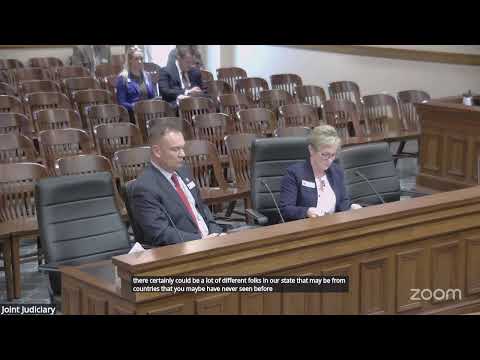
The joint Judiciary Committee on May 12 reviewed model anti‑SLAPP legislation and voted to ask the Legislative Service Office to prepare a bill draft based on the Uniform Public Expression Protection Act. The motion, made during the interim meeting, passed on a voice vote after hours of presentations from LSO staff, the Uniform Law Commission, an Idaho sponsor, and dozens of public commenters.
Tamara Acrola of the Legislative Service Office gave the committee a step‑by‑step overview of how UPEPA works, saying the model statute generally creates a streamlined three‑phase process: an early motion from the defendant to show the claim arises from protected expression; a plaintiff response showing an exception or a prima facie claim; and, if necessary, a final evaluation of whether the plaintiff can prevail. "The purpose of anti‑SLAPP legislation is to prevent or quickly dispose of malicious or frivolous lawsuits," Acrola said, summarizing the model's features including an automatic discovery stay and mandatory fee shifting to deter meritless suits.
Committee members asked pointed questions about the practical effects of that early process. Representative Tesek asked how a summary‑judgment standard could be applied before full discovery; Acrola acknowledged courts have struggled with that tension and said many statutes allow limited targeted discovery or adjust standards to avoid premature factual weighing.
Advocates and experts urged the committee toward the uniform approach. Scott Meyer, Wyoming's commissioner to the Uniform Law Commission, recommended the uniform act for predictability and clear motion practice. Idaho State Senator Brian Lenny, who sponsored a similar measure in Idaho, said the law there "provided an off‑ramp early on" to stop long, costly suits designed to chill public participation. "This bill turned a threat into a liability for the party making it," Lenny told the committee.
Legal and policy groups who testified — including the Goldwater Institute, Institute for Free Speech advisers, and outside counsel who helped draft UPEPA — stressed two drafting priorities: (1) avoid language that forces judges to decide disputed facts that should go to a jury, and (2) try to craft the statute so federal courts applying Erie will treat at least some protections as substantive rather than purely procedural. Mark Jackson of the Goldwater Institute warned that federal district courts have reached different results on UPEPA's federal‑court applicability and recommended care on fee‑shifting and procedural mechanics.
Several speakers urged that fee awards be symmetric — that meritorious anti‑SLAPP movants recover fees and that frivolous anti‑SLAPP motions carry penalties. LSO explained that states vary on whether fee awards are mandatory or discretionary.
Public commenters described cases where litigation was used to silence critics. Michelle St. Louis and Ross Shiffman recounted personal experiences defending defamation claims, and several victims and local advocates urged the committee to act to protect ordinary citizens and small organizations from what they called "lawfare."
After debate, Representative Chestick moved to ask LSO for a bill draft based on UPEPA and tailored to Wyoming practice; the motion was seconded and approved. The chair also directed LSO to report on how freedom‑of‑religion concerns have been treated in other states' anti‑SLAPP statutes and to analyze options for improving the statute's prospects in federal court.
What happens next: LSO will prepare a draft using UPEPA as the starting point, addressing the committee's concerns about discovery limits, jury trial rights, fee shifting, and any religion‑related language. The committee will reconvene to consider the draft before deciding whether to sponsor legislation.
Sources: Legislative Service Office memo presented by Tamara Acrola; testimony from Scott Meyer and Allison Gee of the Uniform Law Commission; Idaho State Senator Brian Lenny; public comments from civil‑liberties and legal groups.